

Reinhardt breaks down income statements
Filed under: Health data, Public records, Studies
Princeton economist – and Health Journalism 2009 keynote speaker – Uwe Reinhardt’s latest post on The New York Times’ Economix Blog provides a clear primer on how to read an insurance company’s income statement.

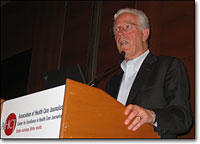
Uwe Reinhardt at Health Journalism 2009
In the post, Reinhardt systematically runs through insurance heavyweight WellPoint’s income statement and, not only explains exactly how major insurers earn their money, but also teaches the reader how to deduce all of this from a publicly available income statement.
Reinhardt promises another blog posting this week that will “explore how the add-ons for marketing, administration and profits on top of expected outlays for health care to set the insurance premiums can be astonishingly high for individually sold policies. Up to half the premium can go for these non-medical items.”
Related
- Princeton economist Uwe Reinhardt’s Health Journalism 2009 presentation on the economics of health care
- Reinhardt calls for price research/transparency
Primer on reform draws from AHCJ presentation
Filed under: Health care reform, Health data, Health journalism, Hot Health Headline, Studies
Sarasota Health News reporter and editor David Gulliver released his own evaluation of health care reform, drawing on the Dartmouth Atlas and the speech Princeton economist Uwe Reinhardt delivered in “brilliant – and, believe it or not, hysterically funny – style at the Association for Health Care Journalists national conference in April.”

Uwe Reinhardt
After sketching a clear and convincing portrait of a failing system, Gulliver takes his assessment even further, venturing authoritative predictions on what a final health care reform package will look like. Gulliver goes into some detail, with the general idea being that the final product will include a universal insurance mandate, a public option that would only go into effect if that mandate’s goals were not met and increased regulation of the insurance industry. Gulliver’s straightforward, un-muddled approach makes the piece both accessible to a broad audience and interesting even to those who read and write about health for a living.
Find a copy of Reinhardt’s Health Journalism 2009 presentation here.
Reinhardt calls for price research/transparency
Filed under: Health care reform, Health policy, Hospitals, Hot Health Headline
Princeton health economist Uwe Reinhardt – the keynote speaker at Health Journalism 2009 –
spoke to U.S. News & World Report’s Dr. Bernadine Healy about health reform. Their discussion revolved around the lack of transparency in medical pricing and the role it plays in high health care costs and also touched on insurance reform and the research needed to better understand what has caused regional health care cost disparities.
According to Reinhardt, American health care is expensive because our prices are high. It’s a surprisingly obvious statement. When compared to citizens from other countries, Americans pay higher prices for the same health products and services. To reduce this disparity, Reinhardt calls for full transparency in medical pricing and a standardized insurance coverage package.
My wife, May, called up the Princeton hospital and asked what a normal delivery would cost. She got nowhere. I called about a colonoscopy and got the same runaround. So I asked a guy at New Jersey Blue Cross. He just roared. “Are you serious? We pay 50 prices. We pay every hospital a different price. We pay the same hospital five different prices.”
I asked, “Are they public? Can I look them up?” The answer was, “No. That’s proprietary.” Imagine if a bunch of people were blindfolded, shoved into Macy’s, and told to shop prudently.
For years, I’ve argued hospitals should post their fees relative to Medicare. I’ve put it to the White House, the Senate. People look at me: “Are you serious? Transparency?”
Find a copy of Reinhardt’s Health Journalism 2009 presentation here (pdf).
Genetic, environmental factors at work in aging process (#ahcj09)
Aging is a biological, psychological and social process, as four researchers explained at Health Journalism 2009. Aging research is important to learn how to slow down the process. At age 50, humans have about 62 years left of their lives, according to Matt Kaeberlein, Ph.D., assistant professor, Department of Pathology, University of Washington (or we might if we learned how to slow down the aging process).
One of the biggest factor of aging is smoking, which affects reproduction, cardiovascular, pulmonary, skin, bone and neoplasia. Genes actually play the biggest role in lifespan. Kaeberlein noted that there is no reason that the human body has to wear out with time, and aging must be “programmed.”
Independent journalist Laura Gater writes about the panel - links to the speakers’ presentations are included.
Blog breaks down Wyden’s talk, plan (#ahcj09)
AHCJ board member Ivan Oransky blogged about Sen. Ron Wyden’s talk at Health Journalism 2009 on April 17.
Wyden’s Healthy Americans Act would require nearly everyone to buy health insurance. He believes the way to pay for everyone to be covered is by limiting the tax-exempt status of health insurance premiums.
Oransky lays out some details about Wyden’s plan and brings up some questions that the senator didn’t answer during his presentation.
Safety initiatives borrowed from transportation industry (#ahcj09)
Patient safety improvement and medical error prevention programs in U.S. hospitals often take their inspiration from the aviation industry’s long-standing efforts to prevent errors and from Toyota Motor Corporation’s “lean” production system, with its celebrated “stopping the line” policy, in which anyone working on the auto production line can stop it until an identified quality problem can be fixed.
Two explicit examples from Seattle’s Virginia Mason Medical Center and Seattle Children’s were described during a panel at the Association of Health Care Journalists annual meeting in Seattle on April 17.
Independent writer Larry Beresford reports on the panel.
Mental health reporter blogs from conference (#ahcj09)
Mental health journalist John McManamy is blogging from Health Journalism 2009.
On Thursday he went on the field trip that included the Seattle Biomedical Research Institute, the University of Washington and the Allen Institute of Brain Science.
On Friday he wrote about the disaster panel, the mental health panel and Sen. Ron Wyden’s luncheon address.
Mental health: Reporting beyond the labels (#ahcj09)
If you live with mental illness, tell the truth about it. If you report on mental illness, watch what you say about it.
This was the core advice from panelists on “Mental health: Reporting beyond the labels” on April 17 at Health Journalism 2009 in Seattle.
“People with mental illness are more likely to be victims than perpetrators,” said Jennifer Stuber, assistant professor of social welfare at the University of Washington. But despite the research, many media depictions of these people continue to promote stereotypes of their being dangerous to themselves and others.
Journalist Hilary Abramson writes about the panel.
Doctor shortage a ‘crisis’ in Wash. (#ahcj09)
Marc Ramirez of The Seattle Times writes about Health Journalism 2009, focusing on a panel about medically underserved areas.
He reports that Even as the population of older people and ethnic minorities continues to grow in those communities, the shortage is worsening as many current rural doctors reach retirement age and fewer available candidates emerge from U.S. medical schools.”
“It’s a crisis, there’s no question about it,” said Anita Monoian, chairwoman of the National Association of Community Health Centers.
Costs critical to stories about health care (#ahcj09)
Guest post by Jason Roberson of The Dallas Morning News
For the most part, health care journalists are shortchanging readers by not focusing more on costs, according to Friday’s AHCJ conference panel, “Explaining costs in health stories.”
Health care costs represent 16 percent of the nation’s gross domestic product, but only 28 percent of health-related stories cover costs, according to Gary Schwitzer, publisher of HealthNewsReview.org. His assessment comes from a three-year study of more than 750 health care stories.
In one of Schwitzer’s examples from the Associated Press, the writer failed to mention that the price of a new breast cancer drug would cost several thousands of dollars a month, putting it out of reach for most patients.
“Do you care about people like this when you write these stories?” Schwitzer asked.
Other panelists expounded on alarming health care cost increases and the need for clarity.
“Ten years from now we’ll be spending $4 trillion in health care,” said Glenn Melnick, professor at the University of Southern California. “Those are almost [Troubled Assets Relief Program] numbers.”
Health insurance premiums are not experiencing the same double-digit increases seen earlier in the decade, said Melnick, citing a recent PricewaterhouseCoopers report. But in such stories, journalists error in not explaining other insurance cost trends, like so-called benefit buy downs, where increased cost sharing or reduced benefits within the policy lowers nominal premium but not the real total cost, Melnick said.
In kicking off the panel discussion, moderator Julie Appleby, AHCJ board member and Kaiser Health News senior correspondent, offered two simple questions to help steer health care reporting in the right direction.
Said Appleby: “How much is it going to cost? And who is going to pay for it?”

