A new wave of hospital consolidation looms
Nationally, the hospital consolidation craze has leveled off since its 2006 peak, but Kaiser Health News senior correspondent Julie Appleby, an AHCJ board member, reports that acquisitions are on the march again, especially in the mid-Atlantic region. Appleby found that this rising wave is due, in part at least, to health care reform and its emphasis on integrated care and Accountable Care Organizations.
Hospital leaders from Baltimore to Seattle say the health law approved by Congress in March gives them even more reason to merge with or buy rivals because of its emphasis on integrated systems where hospitals and doctors better coordinate care.
Also fueling the trend: More doctors want to be employed directly by hospitals, allowing them more job security without the hassles of running a business. But hiring groups of doctors can be an “expensive and daunting proposition” for a stand-alone facility, says Steven Thompson, senior vice president for Johns Hopkins Medicine.
Nationally and locally, he says, “it’s fair to say that (independent) hospitals are talking with everyone, feeling that they don’t want to be the last one standing.”
Other causes include increasingly contentious negotiations with insurers, more direct employment of doctors and access to the capital needed to adopt things like electronic medical records.
We were pointed to the KHN story by AHCJ Immediate Past President Trudy Lieberman’s cjr.org column, in which she compares hospital consolidation to HMOs and insurance consolidation.
It was good to see Appleby’s story, because the media pretty much gave hospitals a bye during the reform debate, instead making insurance companies the saga’s primary villains. Quietly, though, it seems the hospitals were up to the same thing as the insurers—organizing themselves into larger and larger groups with tons of market power to keep insurance premiums in the stratosphere.
Corporations push domestic medical tourism
AHCJ Board Member and Kaiser Health News reporter Julie Appleby explores the emerging phenomenon of domestic medical tourism, a catchy name for the corporate art of comparison-shopping for hospitals across the country.
Photo by contraption via Flickr
“By steering workers to facilities with high-quality care and lower prices,” Appleby writes, “employers say they can reduce their costs 20 percent to 40 percent — more than enough to cover the travel expenses.” The reduction in the cost comes not just from cheaper service, but because treatment at higher-quality centers leads to fewer complications.
There’s no universal national clearinghouse for the sort of data companies are using for this comparison shopping, and each of the field’s pioneers seem to have a different method. At least one uses the hospital ratings produced by Health Grades, while Lowes has signed a deal with the Cleveland Clinic. Employees are sometimes reluctant to travel, but the prospect of cheaper, better care has proved attractive.
Appleby’s sources found the trend difficult to quantify, but clearly growing.
AHCJ board names new officers
The AHCJ board of directors elected a new set of officers to take their seats at the upcoming fall board meeting.
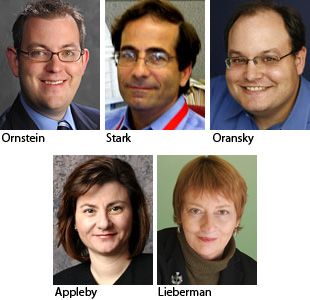
Charles Ornstein of ProPublica was selected as president, Karl Stark of The Philadelphia Inquirer was named vice president, Ivan Oransky of Reuters Health was named treasurer and Julie Appleby of Kasier Health News was named secretary. Trudy Lieberman, board president for the past five years, assumes the new role of immediate past president.
A new board was seated after July elections by the entire AHCJ membership. The board members then voted on officers.
Other members of the board of directors are Felice J. Freyer of The Providence Journal; Phil Galewitz of Kaiser Health News; Andrew Holtz, a Portland, Ore., independent journalist; Carla K. Johnson of The Associated Press; Maryn McKenna, an independent journalist and author; Mike Stobbe of The Associated Press; and Irene Wielawski, an independent journalist from Pound Ridge, N.Y.
The Association of Health Care Journalists is an independent, nonprofit organization dedicated to advancing public understanding of health care issues. Its mission is to improve the quality, accuracy and visibility of health care reporting, writing and editing. AHCJ is housed at the Missouri School of Journalism.
Costs critical to stories about health care (#ahcj09)
Guest post by Jason Roberson of The Dallas Morning News
For the most part, health care journalists are shortchanging readers by not focusing more on costs, according to Friday’s AHCJ conference panel, “Explaining costs in health stories.”
Health care costs represent 16 percent of the nation’s gross domestic product, but only 28 percent of health-related stories cover costs, according to Gary Schwitzer, publisher of HealthNewsReview.org. His assessment comes from a three-year study of more than 750 health care stories.
In one of Schwitzer’s examples from the Associated Press, the writer failed to mention that the price of a new breast cancer drug would cost several thousands of dollars a month, putting it out of reach for most patients.
“Do you care about people like this when you write these stories?” Schwitzer asked.
Other panelists expounded on alarming health care cost increases and the need for clarity.
“Ten years from now we’ll be spending $4 trillion in health care,” said Glenn Melnick, professor at the University of Southern California. “Those are almost [Troubled Assets Relief Program] numbers.”
Health insurance premiums are not experiencing the same double-digit increases seen earlier in the decade, said Melnick, citing a recent PricewaterhouseCoopers report. But in such stories, journalists error in not explaining other insurance cost trends, like so-called benefit buy downs, where increased cost sharing or reduced benefits within the policy lowers nominal premium but not the real total cost, Melnick said.
In kicking off the panel discussion, moderator Julie Appleby, AHCJ board member and Kaiser Health News senior correspondent, offered two simple questions to help steer health care reporting in the right direction.
Said Appleby: “How much is it going to cost? And who is going to pay for it?”
Appleby to report for Kaiser Health News
After 10 years at USA Today, where she covers the health care industry for the business section, Julie Appleby has taken a position as senior correspondent for Kaiser Health News, a new, independent news service that will provide coverage of health policy issues.
The new service is funded by the nonpartisan Kaiser Family Foundation. Stories produced by KHN will be provided free to newspapers around the country and will appear on a KHN Web site, which will go live later this spring.
Appleby, a member of AHCJ’s board of directors, will report on the health care industry, state and national efforts to change the U.S. health system, ways that consumers and employers try to deal with rising costs and other topics.
“More than ever, readers need insightful coverage of the complex and contentious debate over how to solve the quality, cost and access problems facing the U.S. health system,” Appleby says.
“I’m thrilled to join the team at KHN to help do just that. I believe that foundation-funded news organizations (ProPublica in New York is another example) hold great promise to help preserve quality journalism.”
Appleby joins an experienced team of journalists, including Laurie McGinley, formerly of The Wall Street Journal; Peggy Girshman and Mary Agnes Cary, both formerly of Congressional Quarterly; and John Fairhall, formerly of The Sun in Baltimore.
AHCJ reported on the formation of KHN and a project in California that is blending foundation support with experienced journalists. To read more about KHN and foundation-supported journalism, here’s a story from The New York Times.