Quake damage could cripple Calif. hospitals

In her series on earthquake preparedness at California hospitals, California HealthCare Foundation Center for Health Reporting senior reporter Deborah Schoch look at what she calls the “Achilles heel” of hospitals in earthquake territory: internal damage to pipes and equipment.

While much of the legislative focus has been on preventing structural damage, Schoch writes that recent seismic disasters in places such as Chile and Japan have demonstrated that a broken water pipe or sprinkler system can shut down a hospital every bit as effectively as a crumbled wall.

To better avoid internal damage, Schoch writes, hospitals need to bolt down equipment, anchor water tanks and set up back-up generators. According to Schoch, “Many facilities locally and statewide are still years or decades away from making those non-structural internal fixes, even though they are required under California law.” This is largely thanks to a variety of deadline extensions and loopholes requested by cash-strapped hospitals which refer to the law as the largest unfunded mandate in state history.

As of 2009, fully 1,357 hospital buildings statewide had not made fixes that should have been finished at the start of 2002, according to a December 2009 report from state regulators.

Another 1,233 buildings, or 95 percent of buildings statewide, had not yet done improvements that were due Jan. 1, 2013, according to the report. State officials caution that some hospitals may have completed upgrades, but they do not have up-to-date statistics.

In the second installment of the series, Schoch uses state records to show that more than 40 hospitals close to the fault are rated at high risk of collapse in a major earthquake.

California hospitals were supposed to have fixed hospitals by 2008 or the state would shut them down. But that deadline has been pushed back multiple times: “Championing the delays, the state Legislature repeatedly extended the 2008 deadline to 2013, 2015, even 2020, under pressure from hospitals that said they can’t afford the fixes.”

Joplin hospital staff took action during disaster

Aug. 10th, 2011 by Andrew Van Dam · 1 Comment
Filed under: Hospitals, Hot Health Headline 

If you haven’t already, take 90 seconds to read Tulsa World reporter Michael Overall’s brief, powerful account of how emergency preparedness translated to emergency action at the hospital caught in the center of the May tornado in Joplin, Mo.

joplin-hospital

Photo by Red Cross: Carl Manning GKCARC via Flickr

The staff had practiced severe weather drills and evacuations hundreds of times but, as one administrator told Oklahoma colleagues, “There’s no way you can plan for an F-5 tornado.” Nevertheless, Overall writes, the well-drilled staff of St. John’s hospital “evacuated all 183 patients in just 90 minutes with no major injuries,” a sentence you won’t appreciate until you read Overall’s narrative based on a hospital administrator’s talk at a conference for regional emergency workers.

For those of you looking for story ideas, you might look into local hospitals’ disaster plans. Have they really planned for every contingency? Certainly there are things no one can plan for, but it’s worth reading the story from this hospital and evaluating disaster plans with those events in mind.

For more, read AHCJ’s roundup and review of Joplin tornado coverage.

Journalists must heed ethics in disaster coverage

Mar. 21st, 2011 by Pia Christensen · Leave a Comment
Filed under: Health journalism 

A little more than a week after the historic earthquake, tsunami and nuclear emergency in Japan, journalists are beginning to reflect on our profession’s performance. How good a job of getting the news and informing the public have we been doing?

The run on iodine tablets up and down the U.S. west coast is a discouraging example of the limited ability of the many balanced news reports about radiation risk – and iodine risk, including serious allergic reactions – to quell panic-buying. It’s Cipro and anthrax all over again.

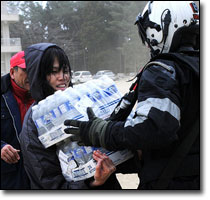
Sailor provides food and water to Japanese citizens during relief efforts. Photo: Official U.S. Navy Imagery via Flickr

Sailor provides food and water to Japanese citizens during relief efforts. Photo: Official U.S. Navy Imagery via Flickr

Recently, AHCJ posted a statement about some of the ethical issues that face journalists reporting from disaster zones. The statement focuses on the public service value of reporting from disaster zones and the imperative that the spotlight must remain on the people and events reporters observe, not the reporters themselves.

“In summary,” the statement concludes, “do not exploit vulnerability for gain or glory.”

Each disaster is different. The people of Japan are not interchangeable with the people of Haiti. Nevertheless, journalists inevitably encounter people who need help. The need may be for a bottle of water or for urgent medical care. Aid should be given freely, without creating a sense of obligation. When one hand offers a thirsty person a bottle of water, while the other hand holds a microphone, is consent to be interviewed truly unencumbered? Or does such an exchange inevitably plant the thought in a person’s mind that the interview is payment for the water?

There are legions of aid workers moving into the northeast coastal region of Japan. Reporters seeking to tell stories of the people providing care and those receiving it should have no trouble finding examples. Stories that feature the acts of a reporter have an inherent “look at me!” aspect that offers no additional value to readers and audiences.

Every day and every story is unique, so it is impossible to say without exception how a journalist should act in each and every circumstance; yet when we intrude on a scene of personal suffering, we should always remember why we are there.

M.D. journalist suggests guidelines for dual roles

Tom Linden, M.D., looks at the role of physician reporters in covering disasters, particularly in light of the Haiti earthquake which saw a number of high-profile physician reporters cover the story and render care.

As Linden points out in the Electronic News journal, the networks promoted their reporters’ medical efforts and showed them providing care. He brings up a number of relevant questions about the duties of a physician reporter, whether network s or stations should promote them providing care, privacy of patients and more.

Beyond asking questions and discussing the implications of such coverage and promotion, Linden proposes a set of guidelines “to help clarify boundaries between medical and journalistic practices.”

In short, he says it’s bad journalism and inappropriate for physician reporters to report on themselves providing care.

When physician journalists become the story, medical reporting loses its way.

Linden, a professor of medical journalism in the School of Journalism and Mass Communication at the University of North Carolina at Chapel Hill and director of the medical and science journalism program, is no stranger to the subject, as he has worked as a medical journalist for CNBC and local news stations.

Related

MSNBC tells of earthquake amputees, soldiers

Mar. 30th, 2010 by Andrew Van Dam · Leave a Comment
Filed under: Hot Health Headline 

In the aftermath of the Haiti earthquake, an MSNBC team has set out to cover, through a variety of media, an American prosthetic group working at a rural hospital to fit limbs to hundreds of earthquake amputees. At the same time, the team is sharing personal essays written by American soldiers who lost limbs in Iraq and Afghanistan. It’s an unusual post-disaster focus that has yielded some impressive stories.

Here are a few of the most notable dispatches:

Is U.S. ready for Haiti-style mass casualty event?

The GAO’s latest release, “State Efforts to Plan for Medical Surge Could Benefit from Shared Guidance for Allocating Scarce Medical Resources (20-page PDF),” is the result of an evaluation of the nation’s medical capacity to deal with “mass casualty events,” a response they refer to as a “medical surge.” Read the one-page summary here. The release is a summary of a similarly titled 2008 report, but it has gained extra relevance in the light of the U.S. response to the similar circumstances of the 2010 Haiti earthquake.

The report found that states were making good progress in developing bed reporting systems and coordinating with military and veterans hospitals, as well as in selecting alternate care sites and registering medical volunteers. It also noticed that they were lagging when it came to planning for altered standards of care.

Related

IoM: We need clear guidelines for disaster triage
What really happened at Memorial after Katrina?
AHCJ presentation: How prepared is your city for a health disaster? (Audio)
Protecting the Public’s Health from Disease, Disasters, and Bioterrorism


IoM: We need clear guidelines for disaster triage

Sep. 29th, 2009 by Andrew Van Dam · 1 Comment
Filed under: Health policy, Hot Health Headline 

AHCJ president Charles Ornstein, with Sheri Fink, M.D., writes for ProPublica about the report of an Institute of Medicine committee indicating “urgent and clear need” for consistent national guidelines for care during catastrophes, “particularly on such thorny questions as which patients should receive scarce treatments or equipment and which should go without.”

The report calls for ethical guidance and specifically notes that such decisions should not be made on the basis of “Do Not Resuscitate” orders, as Fink showed they were in Memorial Hospital in New Orleans in the days after Katrina. The panel was less clear when it came to naming exactly which tools should be relied on to make touch decisions after disasters, saying that further research was necessary.

What really happened at Memorial after Katrina?

In a story that is being co-published by The New York Times Magazine and ProPublica, Sheri Fink, M.D., painstakingly reconstructed the hectic, troubling events that transpired at Memorial Medical Center in New Orleans in the days after Hurricane Katrina swept through the city. In that time, 45 patients died at the center – more than at any comparable hospital in the area – and, although a grand jury did not issue any indictments in relation to the deaths, there are indications that some of the deceased patients may have been euthanized.

Fink “obtained previously unavailable records and interviewed dozens of people who were involved in the events at Memorial and the investigation that followed.” She writes that more medical professionals and more patients were involved than previously thought and that “Several were almost certainly not near death when they were injected, according to medical professionals who treated them at Memorial and an internist’s review of their charts and autopsies that was commissioned by investigators but never made public.”

In addition to the doctors, nurses and patients involved in the controversial deaths, Fink also tells the story of the coroner and investigators charged with untangling the post-Katrina events at Memorial Medical Center and how they struggled to administer justice while taking into account the extraordinary circumstances that followed the hurricane.

The extensive package includes a video interview with Fink about how her background as a physician, humanitarian aid workers and previous reporting on medical care in wartime conditions helped her report this story.

Preparation would lessen chaos in covering disasters (#ahcj09)

Apr. 20th, 2009 by Pia Christensen · Leave a Comment
Filed under: Health journalism 

Disasters are a time of chaos and uncertainty. To perhaps lessen this chaos for reporters, a panel of experts at Health Journalism 2009 in Seattle discussed how journalists might cover and survive disasters as well as understand the medical systems in place to handle them. The panelists offered insight into the many wheels set in motion when a disaster strikes and how journalists can prepare for and understand what might happen should one hit their community.

Thomas Cullen of the Missouri School of Journalism summarizes this panel from Health Journalism 2009.