Baby’s death illustrates how health IT can introduce complexity, error to system
Filed under: Health care reform, Hospitals, Hot Health Headline, Pharmaceuticals
Chicago Tribune reporters Judith Graham and Cynthia Dizikes explore the pitfalls of health information technology through the story of an infant boy who survived despite being born months early and weighing just 1.5 pounds, only to be killed by a sodium chloride overdose when a pharmacy tech entered information into the wrong field of his electronic medical record.
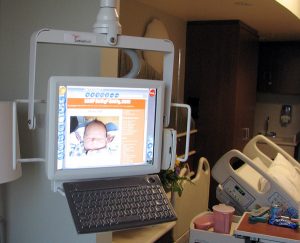
Photo by Christiana Care via Flickr
The tech’s fatal clerical error was compounded by disabled alarms on a compounding machine, incorrect labeling on an IV bag and an ignored lab test. The heart of the errors, the reporters write, seems to be that all the different systems involved don’t communicate.
Almost all medication requests at Advocate are transmitted by a doctor’s keystroke to the hospital pharmacy’s drug-dispensing system. But in this case, there was no electronic connection with the automated compounding system that prepared the IV bag for baby Burkett, a specialized device that handles low-volume, highly individualized orders.
So a technician transcribed the order by hand, and an error was introduced.
Electronic communication gaps are common at large hospitals, which typically use upward of 50 to 100 different information systems at their facilities, with different technologies used in emergency rooms, labs, pharmacies and other medical departments, said Ross Koppel, a sociologist at the University of Pennsylvania who studies health information technologies.
“To some degree these systems talk to each other, but mostly they don’t, so hospitals have to design custom-made software ‘bridges’ to make this happen,” Koppel said. With each jury-rigged software solution comes the potential for new software bugs, transcription errors and other problems.
Explain elements of health reform through the eyes, stories of doctors
In these posts about covering health reform, I usually don’t point to the big national dailies because a lot of people have already read those stories but a recent New York Times piece, “As Physicians’ Job Change, So Do Their Politics” is a story that may be able to help reporters think about a good local or regional jumping off point for telling aspects of the health reform story in a more narrative, accessible manner, through the eyes and experiences of doctors.
What questions do you have about health reform and how to cover it?
Joanne Kenen is AHCJ’s health reform topic leader. She is writing blog posts, tip sheets, articles and gathering resources to help our members cover the complex implementation of health reform. If you have questions or suggestions for future resources on the topic, please send them to joanne@healthjournalism.org.
The Times story, by Gardiner Harris, described a shift leftward (or at least less rightward) among physicians. He cited several reasons: younger doctors, more female doctors, and above all more doctors who are salaried employees of hospitals instead of basically being small businessmen (or women) running a practice.
Because so many doctors are no longer in business for themselves, many of the issues that were once priorities for doctors’ groups, like insurance reimbursement, have been displaced by public health and safety concerns, including mandatory seat belt use and chemicals in baby products.
Even the issue of liability, while still important to the A.M.A. and many of its state affiliates, is losing some of its unifying power because malpractice insurance is generally provided when doctors join hospital staffs.
He wrote mostly about Maine, but had a few observations about other states, including Texas. Last year Texas physicians opposed the national health reform law by a three to one margin. But doctors who did not have their own practices were twice as likely to support the law. The same goes for female doctors.
How does a story about physician politics translate into a narrative about health reform?
The shift to salaried positions has many causes (including work-balance for doctors who want more time with their families) but the move toward more clinical integration and the formation of accountable care organizations or ACO-like entities will hasten this trend. It is really, really, really hard to explain ACOS clearly and concisely (when an editor of mine recently asked me to give him a nice, tight two-graf description, I began it something like, “One of the challenges of ACO is that they defy simple explanation.”)
But doctors who are joining hospital staffs or whose practices are being bought up by hospitals or who are entering different contractual relationships and affiliations with hospitals have stories to tell. You can also talk about quality measures and “never events” and how that affects physicians and the practice of medicine, particularly in states mandating more public reporting. Through their stories, you can illustrate what an ACO is or isn’t, or how a medical home works, or what “clinical integration” means.
I interviewed a physician in South Carolina the other day, Dr. Angelo Sinopoli, who told me about how the team approach and the use of electronic medical record with clinical decision support was giving him more real-time feedback on his own performance – and he welcomed it.
“You think you are doing something and you might not be, or think you might not be, but you are,” he said. “Seeing real data in as real time as possible made a difference in how we think.” That made me understand an aspect of the electronic medical record that I hadn’t understood before, and readers can grasp that too.
You can explore the changing attitudes and politics along with that – in some states that may be more significant than others, depending on what your state is doing with health exchanges, malpractice legislation, quality reporting etc.
Editor’s note:
Learn more about how electronic health records could mean new opportunities to improve clinical care and public health, according to David Blumenthal, M.D., the former national coordinator for health information technology. Blumenthal spoke at Health Journalism 2011 as he was leaving his federal position.
Audit: UK’s health IT program falls short of expectations
Filed under: Europe, Health care reform, Health policy
After a damning report from the U.K.’s national audit office indicating that the National Health Service’s massive health IT program has essentially been a black hole which vacuums up far more money than its lack of progress would justify, politicians are now calling for what amounts to the program’s termination.
Physicians support a national system of health records, but there seems to be a consensus that, in the current climate of British austerity, it may be time to amputate the program to stop the bleeding. After all, the audit indicated that despite a seven-year extension, it looks like the program has no chance of meeting its 2014-15 deadlines, or even of producing meaningful results. Here’s Polly Curtis in The Guardian.
The original aim of the £11.4bn NHS IT programme – to install a patient record database accessible from any point in the NHS in England by 2015 – will fail, the National Audit Office (NAO) warned.
The £2.7bn spent so far on the system has not been value for money, the watchdog said, adding it had no confidence that the remaining £4.3bn would be any better spent.
The nine-year-old project – the biggest civilian IT scheme attempted – has been in disarray since it missed its first deadlines in 2007. While its ambitions have been downgraded in recent years, the bill from the suppliers has remained largely unchanged, the report said.
ER scribes handle EMRs, free up doctors
St. Louis Post-Dispatch reporter Michele Munz has found that some emergency rooms are easing the transition to electronic medical records by hiring “scribes” to enter information into the system, thus freeing up the doctor to focus on the actual patient.
Photo by MC4 Army via Flickr
Munz reports that scribes are often young, well-trained, tech-savvy pre-med types who get $8 to $10 an hour and plenty of real-world clinical observation for their trouble. The use of one California-based company’s scribes has grown sevenfold in the past two years, expansion its CEO called “exponential.”
Munz’ story shows that the growth is driven by the desire to ameliorate productivity hits that many hospitals have faced in the wake of EMR adoption.
After the switch to computer records, emergency departments have reported a loss in productivity. At DePaul, patient wait times initially increased 28 percent and patient satisfaction declined 40 percent despite additional staffing, said Dr. Stephen Larson, director of the hospital’s emergency department. St. John’s Mercy also reported a peak in wait times.
While both hospitals have seen wait times drop as doctors get past the learning curve, the emergency physicians group at DePaul decided to begin the scribe program in December “to allow us to continue to add to our gains,” Larson said.
New EHR error-reporting system to keep data confidential
Filed under: Government, Health care reform, Health data, Health journalism
EHRevent.org, a service that will allow health workers to report and track errors associated with electronic health records, has launched with broad support and no small amount of fanfare. In cooperation with the federal government, the new system will be run by the iHealth Alliance and the PDR network. The iHealth Alliance already runs the Health Care Notification Network, while the PDR Network, perhaps best known for their Physicians Desk Reference, already distributes FDA warnings and drug labeling information.
It shows promise, of course, but that promise comes with one hefty caveat for health journalists: The resulting data will be kept under wraps. Wall Street Journal health blogger Katherine Hobson has the details:
The aggregated data will be available to medical societies, liability carriers and agencies such as the FDA, but will remain confidential — and won’t be subject to legal discovery. (The mechanism for this type of information sharing is the patient safety organization, federally sanctioned groups formed by providers, nonprofit groups and other interested parties to analyze data about medical errors. Groups can get aggregated data if they agree to keep it out of the public domain.)
Schulte, Schwartz look for help investigating HIT
Filed under: Health data, Health journalism, Hot Health Headline
Regular readers know that we always keep an eye out for updates from Fred Schulte and Emma Schwartz, the duo from the Huffington Post Investigative fund that refuses to let the Obama administration’s push for health information technology proceed without scrutiny. This time, they’re following up on past work with stories on HIT-related errors and the FDA’s role (or lack thereof) in the policing of HIT.
Their most interesting update, however, concerns their effort to get HIT-related “adverse events” data from the FDA. Schwartz describes the difficulties they’ve run into, how they’ve overcome them, and how readers can help them put the whole puzzle together. It’s an interesting strategy, and an equally interesting primer on the FDA’s tricky “Manufacturer and User Facility Device Experience,” or MAUDE, database. You can also find their own version of the data here, courtesy of Amanda Zamora.
Attending Health Journalism 2010?
Schulte will be speaking about “Tracking health-related stimulus money” during a panel at 4:15 p.m. on Friday. His co-panelists will be ProPublica reporter Michael Grabell and Phil Galewitz, a Kaiser Health News reporter and AHCJ board member.
On Sunday morning, don’t miss the panel “Personal electronic medical records: What will consumers need to know?” featuring:
- Steve Gray, partner, Affiliated Computer Services Healthcare Solutions
- Bala Hota, M.D., M.P.H., chief medical information officer, Cook County Health and Hospital System
- Thomas Layden, M.D., chief, Department of Internal Medicine; professor of medicine, University of Illinois at Chicago
- Moderator: Prerna Mona Khanna, M.D., M.P.H.. visiting clinical associate professor, University of Illinois College of Medicine
Report: Smart phones are changing health care
For the California HealthCare Foundation, Jane Sarasohn-Kahn created a 23-page report titled “How Smartphones Are Changing Health Care For Consumers And Providers (PDF).” The report’s key message is that, while doctors have been slow to adopt EMRs and other forms of HIT, they’ve been quick to adopt smart phones. And thus it would seem smart phone apps could hold the most promise of practical HIT implementation in the coming years. Especially since, Sarasohn-Kahn writes, Manhattan Research has found that “the number of physicians who own smart phones will increase from 64 percent in 2009 to 81 percent by 2012.”
The speed of the uptake has been remarkable for a nation that has been traditionally slow to adopt HIT, as Figure 1 shows. Two-thirds of physicians used smartphones in 2009. About 6 percent of these were using a fully functional electronic medical record or electronic health record system — while only 1.5 percent of hospitals had a comprehensive electronic health record system as of 2008.
And the promise and popularity of health on smart phones has led to a corresponding boom in apps, Sarasohn-Kahn writes. Right now, she says, “Some of the most widely used mobile applications by physicians are drug and clinical references, and clinical tools such as dosage calculators.”
For clinicians, the smartphone offers an alternative to many health IT formats that have been cumbersome and costly to adopt, and that may interrupt their workflow. As of February 2010, there were 5,805 health, medical, and fitness applications within the Apple AppStore. Of these, 73 percent were intended for use by consumer or patient end-users, while 27 percent were targeted to health care professionals. It should be noted that, although developers usually have a principal audience in mind, all users can and do download the apps. In the “medical” category, 33 percent of apps are meant for consumers/patients, 32 percent for physicians, 17 percent for medical students, 4 percent for other health professionals, and 2 percent for nurses.
In addition to her market statistics, Sarasohn-Kahn breaks the applications down into key categories, the most interesting of which are:
- Linking physicians to up-to-the-minute safety alerts on a local and national scale
- Delivering instant lab results
- Remote monitoring of patients and their vital statistics, as well as the issuance of related alerts
- Consulting with other physicians remotely
- Monitoring patient compliance with treatment recommendations and guidelines
Patient data errors force VA to close EMR system
Nextgov’s Bob Brewin reports that errors in patient data have forced the Department of Veterans Affairs to close access to the Bidirectional Health Information Exchange, the Defense Department’s vast electronic medical record system. The bug first surfaced in February when a physician noticed that the system claimed one of his female patients had been prescribed an erectile dysfunction drug. The errors have been blamed on old code in the six-year-old system which could not handle peak usage rates.
The glitch did not cause harm to any patient, but “the potential exists for decisions regarding patient care to be made using incorrect or incomplete data,” said Jean Scott, director of the Veterans Health Administration’s Information Technology Patient Safety Office, in the alert issued on Wednesday.
… The VA clinician may see the patient’s data during one session, but another session may not display the data previously seen,” the alert noted. “This problem occurs intermittently and has been reported when querying DoD laboratory, pharmacy and radiology reports.”
The system is expected to go back online March 9. Until then, Brewin writes, “VA doctors will have to obtain a patients’ health information from their paper medical files, faxes or PDF attachments that are e-mailed to the physicians.”
According to its tagline, Nextgov focuses on “Technology and the Business of Government.”
So-phish-ticated scams target docs, medical records
American Medical News’ Pamela Lewis Dolan writes that sophisticated e-mail scammers are targeting doctors in attempts to get medical records and use the wealth of information they contain to facilitate identity theft.
The scammers pose as someone, such as an information technology worker, with whom a doctor regularly corresponds and exchanges sensitive information, then ask the doctor to share a password or download a piece of software that will then allow the would-be hacker to access medical records. Dolan writes that these attacks are often facilitated by disgruntled employees that can provide scammers with the inside information needed to develop a convincing ruse.
“The best way to convert data to cash is ID theft,” said Tom Cross, manager for X-Force Advanced Research, IBM’s data theft research team. Medical records provide a comprehensive portfolio for individual identification, and that can be sold, he said.
In addition to tips for avoiding these scams, Dolan gives a few recent examples.
One recent phishing case was carried out by scammers who posed as the Centers for Disease Control and Prevention and sent e-mails to patients and doctors claiming everyone had to register at an online H1N1 vaccine database. A link in the e-mail took unsuspecting recipients to a Web site that looked as if it was operated by the CDC. A warning issued later by the real CDC indicated hackers were likely sending malicious software downloads to victims’ computers.
Federal EMR budget slashed, switchover delayed?
Fred Schulte and Emma Schwartz have put together the latest installment in the Huffington Post Investigative Fund’s ongoing look at electronic medical records, this one focusing on how budget cuts could make it more difficult to meet the administration’s targets for nationwide adoption of electronic records.
In May, budget officials estimated they would spend up to $47 billion in stimulus money to help doctors and hospitals purchase the systems. But in a press briefing on Wednesday, officials said that figure had been chopped nearly in half to between $14.1 billion and $27.3 billion.
A program like this has never been done on this national scale,” Tony Trenkle, who directs the office of e-health standards and services for the federal Centers for Medicare and Medicaid Services, told the Huffington Post Investigative Fund in an interview.