FDA creates embargo policy in response to reporter concerns
The Food and Drug Administration has adopted a policy on embargoes that permits reporters to share embargoed information with outside sources, provided the sources agree to uphold the embargo.
The policy explicitly supports embargoes as a way for reporters to add depth and detail to their stories, and conforms to common practice among medical journals and other sources of complex information.
The policy was shared with AHCJ this week after complaints from the organization earlier this year. In January, the FDA barred reporters from interviewing experts about new regulations on medical devices until the embargo lifted. AHCJ wrote to the FDA that such an approach created obstacles to serious journalism.
In an embargo, the group releasing information chooses the time and date that it will be made public, and reporters get an advance look as long as they agree to delay publication or broadcast until that time. Reporters are willing to do this because it allows time digest the information and seek comments from experts.
In a letter this week to AHCJ, the FDA outlined its policy going forward:
“A journalist may share embargoed material provided by the FDA with non-journalists or third parties to obtain quotes or opinions prior to an embargo lift provided that the reporter secures agreement from the third-party to uphold the embargo.”
The letter, from Meghan H. Scott, FDA’s acting associate commissioner for external affairs, said the FDA did not previously have a policy on embargoed news. After AHCJ’s inquiry, she wrote, the media staff met with AHCJ members, other journalists, and editors of medical and scientific journals as it worked to develop a policy.
“The FDA is committed to a culture of openness in its interaction with the news media and the public,” Scott wrote to Charles Ornstein, AHCJ president, and Felice Freyer, chair of AHCJ’s Right to Know Committee.
She specified that the FDA may provide embargoed information when:
- the issue is not related to regulatory or enforcement issues and does not contain confidential, commercial information; and
- the subject is complex or technical and early access to materials and subject matter experts will help reporters prepare their articles in a timely, accurate manner with the context needed to understand the material.
“We’re grateful that the FDA media staff took the time to study the issue and develop a suitable policy,” Freyer said. “The results are clear rules that are reasonable and workable – and a step forward in improving relations between the FDA and the media.”
MSNBC: FDA had concerns 2 years before alcohol wipe outbreak, didn’t act
Filed under: Government, Health journalism, Hot Health Headline
JoNel Aleccia and the folks at MSNBC.com have dug in deep on news of the FDA’s Jan. 5 recall of tainted alcohol wipes, spurred on by the death of a Texas toddler and complaints from across the country. Aleccia’s findings seem to indicate that, more than a month after the recall, the case of Triad Groups’ trainted products and related failures of FDA oversight may run far deeper than the original notice implied.
Aleccia’s been helped in the follow-up investigation by unofficial access to FDA records, validated by outside sources, that indicate inspectors detected problems in 2009, and again in 2010, but didn’t act until this year’s recall.
Documents show that FDA officials expressed concerns following visits to the Triad plantfrom July 15 to July 17, 2009, and again from April 19 to May 18, 2010. Inspectors reported that the company could not validate the processes used to ensure quality or sterility not only of alcohol prep pads and wipes, but also other products used for intimate care.
…
The inspection documents, known as FDA Form 483s, were obtained by msnbc.com from a confidential source and confirmed by FDAzilla.com, an independent Web site that monitors the FDA. Copies of the documents were sent to the FDA for review; the agency did not deny their authenticity.
For a thorough roundup of all the points at which warnings surfaced, or at which the FDA could have intervened, check out Aleccia’s full report.
Speaking of FDAzilla.com, it might be a site worth checking out if you’re interested in the FDA’s activities. It’s free and says it has “made millions of pages of FDA data (MAUDE, devices, drugs, 483s listing, FDA employees) more usable and searchable.” The FAQ says most of its data is automatically updated nightly from files posted on FDA.gov.
Reporters urged to insist on response from federal agencies
Filed under: Government, Health journalism, Public records
When the FDA would offer only “no comment” on a notorious incident last summer, Felice J. Freyer, a medical writer at The Providence (R.I.) Journal, was disappointed but not surprised. She published her story about an FDA matter (the use of unapproved IUDs) without the FDA’s input.
But Freyer became concerned when, four days after her story came out, the FDA posted on its website a “consumer update” that answered some, but not all, of the questions she had posed to the agency.
“Turns out the FDA’s position was not the ‘no comment’ I received,” Freyer wrote in an account of the incident posted on the AHCJ website.
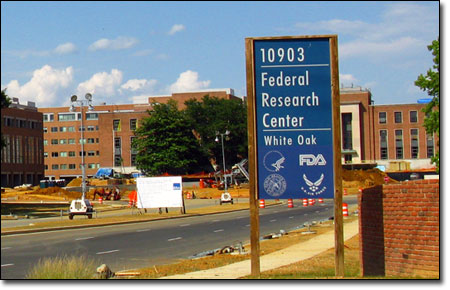
FDA headquarters in White Oak, Md.
(Photo by thisisbossi via Flickr)
“I don’t think the FDA had anything major to hide,” Freyer added. “It seemed like the agency just couldn’t be bothered with my questions, preferring to focus on a statement for release on its own time.”
But the web-only consumer advisory left questions unanswered and probably reached few consumers.
Freyer, who is an AHCJ board member and chair of AHCJ’s Right to Know Committee, complained about the incident, pursuing the matter up the chain of command. She eventually received an apology, but little by way of explanation. She is sharing her experience in the hope of encouraging other reporters - especially the beleaguered folks who work for the regional media - to persist in seeking information from the federal government.
“The Obama Administration has done some admirable work posting user-friendly information on the Internet,” Freyer said. “But as long as the administration’s press officers ignore and deflect reporters’ questions, the government’s websites begin to function like a state-sponsored press, containing only the information the government wants to share, forever impervious to questioning.
“I urge my fellow journalists to push back against this trend.”
Investigating, localizing salmonella outbreak
Filed under: Health data, Health journalism, Hot Health Headline
As some of you may have noticed, there’s an egg recall going on. It all began when the CDC’s PulseNet monitoring program noticed a fourfold jump in the number of salmonella cases being reported, which spurred investigations around the country. This jump is evident in the graph below. Don’t be fooled by the dropoff at the end, it has more to do with the reporting process than with an actual decrease in the number of salmonella cases (which clearly isn’t happening).
Health officials then traced it all back to a man outlets love to describe as a sort of rogue Iowa egg magnate and his Wright Country Eggs (satellite view?).
As we stand now, the tainted eggs could have been distributed through any number of channels, but constitute a tiny fraction of the national egg supply.
For reporters digging into this national recall story, or looking to localize it to their coverage area, AHCJ has a strong archive of foodborne illness resources.
Start with a classic, the AHCJ article “Fatal Food: A study of illness outbreaks ,” in which Thomas Hargrove details SHNS’ massive investigation into the nation’s food safety monitoring system. Not only is Hargrove’s how-to instructive, his actual findings are useful examinations of state and local food safety systems around the country.
For your own investigation, look at Mining NLM databases: PubMed, Medline and more and the rich set of resources in the sidebar to Hargrove’s story.
If you’re looking for solid numbers and the most up-to-date national context, see Covering Health’s recent post on the CDC’s lates foodborne illness data, as well as our examination of 2009 foodborne illness rates.
Other relevant Covering Health posts include:
Schneider: FDA lacks resources to keep food safe
CDC assembles rogues gallery of food bugs
Private food auditors didn’t stop outbreaks
Lax oversight, complex supply chains aid outbreaks
GAO: FDA designation doesn’t ensure safety
Filed under: Government, Hot Health Headline, Studies
On his blog Cold Truth (and on AOL News), Andrew Schneider brought our attention to the GAO’s recent investigation into the well-known FDA loophole created by the “generally regarded as safe” or GRAS designation.
The GRAS designation is meant to spare manufacturers lengthy and expensive testing that might otherwise slow the flow of new products to market. It’s conferred, Schneider writes, as long as a “scientific panel selected by the manufacturer can rule that no harm will result from the intended use of an additive.”
Schneider’s version of the highlights of the GAO report:
- The FDA generally doesn’t know about most of these determinations of “generally regarded as safe,” or GRAS, because companies are not required to inform the agency.
- The FDA has not taken steps that could help ensure the safety of additives listed as GRAS.
- Food products may contain numerous ingredients, including GRAS substances, making it difficult, if not impossible, for public health authorities to attribute a food safety problem to a specific GRAS additive.
- The FDA does not systematically reconsider the safety of GRAS substances as new information or new methods for evaluating safety become available.
The GAO said nanomaterials and imported additives were of particular concern.
(Hat tip to OMB Watch in general and Matthew Madia in particular)
Propofol abuse a concern in medical profession
Filed under: Hospitals, Hot Health Headline, Nursing
Alicia Mundy of The Wall Street Journal reports that abuse of the common anesthetic propofol has become a problem the medical profession, where the drug is plentiful and easy to access. The powerful, fast-acting drug enters the bloodstream quickly and makes the user unconscious.
Mundy does note that “The number of people with a propofol problem is small, and there is little data tracking addictions or death.”
The FDA is considering whether to classify propofol as a controlled substance, which professionals say might be problematic because the sedative, which is suspected to have contributed to Michael Jackson’s death, needs to be readily available during emergencies. If it were to become a controlled substance, hospitals would have to “track inventory, account for all vials, list users, and lock it up with narcotics.”
Mundy cites another concern: “Tighter regulation might impede doctors and nurses from seeking help for addiction, because abusing a DEA-controlled drug is more likely to cost them their licenses and lead to criminal charges.”
Hensley: New FDA chief looks to be tough
According to NPR Health Blog’s Scott Hensley, newly confirmed FDA Commissioner Margaret Hamburg sounds like she means business.
Hamburg vowed to speed things up around FDA headquarters, calling the agency’s processing times for some routine tasks “unacceptable.” She also proposed a new system of publishing “close-out letters” on the FDA Web site when companies resolve a problem about which they had been formally warned by the FDA, presumably in the hopes that violators with clean up their act faster with the added motivation of a publicized clean bill of health.
AHCJ speaker writes about physiology of eating
Filed under: Government, Health journalism, Hot Health Headline
The New York Times’s Tara Parker-Pope reviewed former FDA chief Dr. David Kessler’s new book, The End of Overeating: Taking Control of the Insatiable American Appetite. In it, Kessler seems to paint Americans as victims of a carefully calibrated gustatory assault, explaining that the food industry has perfected the art of creating food that “taps into our brain circuitry and stimulates our desire for more.”
Though he did not write a diet book, Parker-Pope says, Kessler does try to help folks enter “food rehab,” where they can use their new awareness of food science to “take back control of our eating habits.”
Kessler will be a spotlight speaker at AHCJ’s Aging in the 21st Century Workshop, set for Oct. 16 and 17 in Miami. Tapping into the expertise and understanding of human psychology and physiology he showed in his book, Kessler will discuss nutrition and aging at the workshop.
Wrestling with the FDA recall e-mail avalanche
Filed under: Health journalism, Hot Health Headline, Public health
NPR’s April Fulton recently blogged about a phenomenon familiar to anyone with a subscription to the FDA’s recall e-mail list, or their RSS feed, or their Twitter account: a late rush of random recall messages that would require a prohibitive amount of time to sort and research.
For example, in a two-minute span on June 15, @FDArecalls on Twitter buzzed with messages about multivitamin labels, fish, organic chocolate peanuts, white peppers and soy sprouts. Fulton also notes that many of the notices come out late in the day.
She proposes some sort of flagging or rating system to make it easier to figure out which stories are big deals and which aren’t. She may be on to something. The FDA could make these releases more accessible and useful for journalists and consumers. At the very least, it should be possible to explain the location and magnitude of the public health danger in a way that could be understood at a glance.
What other tips or tricks help you figure out which recalls are relevant to your readers? Do you have suggestions as to how the FDA could makes its releases more accessible or useful? Let us know.
FDA dropped ball on sketchy syringes
Filed under: Conflicts of interest, Government, Hot Health Headline
According to a report by Christina Jewett of ProPublica and Deborah L. Shelton of the Chicago Tribune, the U.S. Food and Drug Administration — understaffed, overworked and increasingly reliant upon the cooperation and assistance of the industries it’s expected to oversee — allowed a North Carolina plant to ship tainted syringes which have “been linked to at least 4 deaths and 162 illnesses nationwide.”
The reporters chronicle the, the series of FDA internal safeguards that failed to catch the syringes before they were shipped.
- In October 2007, an inspector visited the plant after reports of specks of debris in fluid-filled syringes. She reported that management had a plan to deal with the problem, not noting that their sterilization method was unreliable.
- The company, AM2PAT, announced a recall a week later. This should have triggered an automatic FDA review but the overloaded agency ignores that particular fail-safe unless it judges lives to be on the line.
- In late 2007, as folks started getting sick, the FDA finally gave the plant a detailed inspection, finding a gummy brown substance on the syringe filler and brown water coming from the taps. It was closed in January 2008, but the damage had already been done.
The reporters found the regulatory failures were the cumulative effect of overwork and an increasingly heavy reliance on industry to police itself.
For this article, Gordon Harnack, a consultant who helps medical device companies prepare for inspections, reviewed more than 120 pages of FDA reports on the AM2PAT plant dating to 2005. He said inspectors didn’t look deep enough, and FDA managers were too tolerant.
“Time after time, the evidence was there that [AM2PAT] management had little intent of complying with adequate FDA regulations,” Harnack said. “In 2005, [the FDA] might have caught it. In 2007, they should have caught it. And finally when reports of deaths came in, it all became evident.”
The Propublica/Tribune report exhaustively chronicles AM2PAT’s fraud and manipulation of the system, a history of deception which the FDA failed to act on until it was too late.