Food safety law boosts tracking technology sector
In The Washington Post, reporter Lyndsey Layton digs into the industry spawned by a requirement in last year’s food safety law that producers and processors be able to track food at every step of its journey from farm to supermarket. It applies to everything but meat, poultry and egg products.
Under the law, each business will need to know where the food came from and where it’s going, creating a chain of provenance that the FDA can use to more rapidly trace outbreaks of food-borne illness.
As the September deadline for the launch of the FDA’s first pilot projects looms, Layton writes, no single tracking technology yet predominates. After the pilots, the FDA will report to congress and issue specific rules by 2013.
According to Layton, some food industry segments (not farms or restaurants) have been required to track this data since 2005, “but according to a 2009 investigation by the Department of Health and Human Services inspector general, most food facilities surveyed did not meet those requirements and 25 percent didn’t even know about the law.”
Layton’s story includes a profile of HarvestMark, a company whose barcode sticker is already catching on in some places (Kroger foods has adopted it for store-brand produce, for example). HarvestMark not only allows end consumers to scan their food with a smartphone and figure out where it came from, it also allows them to deliver their feedback to the farmer who produced it.
Conflicts abound for private food inspectors
Filed under: Conflicts of interest, Government, Hot Health Headline, Public health
The Washington Post’s Lena H. Sun has gathered, in one story, a laundry list of all the shortcomings, loopholes and conflicts of interest plaguing an American food inspection system so flawed that foodborne disease outbreaks are routinely caused by facilities with “superior” safety ratings (See Wright County Egg and the Peanut Corporation of America).
Here, I’ve cherry-picked Sun’s basic points. They echo much of what we’ve heard from previous food-safety investigations, despite the fact that each story always seems to end with the FDA pledging to reform the system. Her first observation is also the most fundamental, and will be familiar to anyone following the role of independent credit rating agencies in the financial crisis.
“… auditors are typically paid by the companies they are inspecting, creating a conflict of interest for inspectors who might fear they will lose business if they don’t give high ratings.”
“Food companies often choose the cheapest auditors to minimize the added expense of inspections, which range from about $1,000 to more than $25,000.”
“… foodmakers can prepare for audits because they often know when inspectors will show up.”
“… auditors have a range of experience and qualifications, from recent college graduates to retired food industry veterans. They sometimes walk through a plant, ticking off a checklist to produce a score, Samadpour said. Basic inspections do not typically include microbial sampling for bacteria.”
“The FDA has the authority but not the resources to routinely inspect the estimated 150,000 food-processing plants in the United States or the 250,000 facilities abroad that supply U.S. consumers.”
Raw, warm vegetables breed illness in salsa, guac
Filed under: Government, Hot Health Headline, Public health, Studies
New research implicates guacamole or salsa in 3.9 percent of restaurant-related outbreaks of foodborne illness between 1998 and 2008, more than double the rates of previous measurement periods. Both sauces often combine raw ingredients – tomatoes, peppers and cilantro – that have each been blamed for past outbreaks, the CDC release said.
Photo by anitasarkeesian via FlickrImproper storage and temperature were blamed for 30 percent of the outbreaks, and another 20 percent were caused by worker-related contamination. The outbreaks are common enough that the government even gives them their own acronym (SGA!), an honor that’s admittedly not particularly rare in the world of federal bureaucracy.
CDC began conducting surveillance for foodborne disease outbreaks began in 1973, yet no salsa- or guacamole-associated (SGA) outbreaks were reported before 1984. Restaurants and delis were the settings for 84 percent of the 136 SGA outbreaks. SGA outbreaks accounted for 1.5 percent of all food establishment outbreaks from 1984 to 1997. This figure more than doubled to 3.9 percent during the ten-year period from 1998 to 2008.
According to the release, the primary weapon against such outbreaks is simply the awareness that vegetables are a threat.
“Possible reasons salsa and guacamole can pose a risk for foodborne illness is that they may not be refrigerated appropriately and are often made in large batches so even a small amount of contamination can affect many customers,” (Magdalena Kendall, Oak Ridge Institute for Science and Education researcher) says. “Awareness that salsa and guacamole can transmit foodborne illness, particularly in restaurants, is key to preventing future outbreaks.”
Airport dining proves to be a food safety challenge
Filed under: Hot Health Headline, Public health, Public records
USA Today’s Alison Young reviewed inspection reports for hundreds of restaurants at 10 airports and found a large number of critical violations, including 42 percent of the restaurants reviewed at Seattle-Tacoma and 77 percent of restaurants reviewed at Reagan National Airport.
The most common culprits? “Grab-and-go” sandwiches and related foods, which aren’t kept cold enough to ward off food-borne pathogens.
Young notes that it’s hard to pinpoint the number sickened by airport sandwiches, as it’s difficult to track foodborne illness back to a specific source even when the customers aren’t constantly boarding airplanes and taking off for all corners of the earth.
Scott Hensley, on NPR’s Shots blog, recently noted an FDA warning to a Denver kitchen that prepared thousands of meals a day for airlines:
We can sum up the findings in the LSG SkyChefs facility a few months back with a four-letter abbreviation used to describe the roaches and other insects found there: TNTC.
That stands for Too Numerous To Count.
Hensley runs down some of the other problems found there and a reaction from the company spokeswoman.

AHCJ resources
Lifting the shroud: Using multiple-cause-of-death data
Fatal Food: A study of illness outbreaks
Recent news
Loophole allows E. coli-tainted meat to be sold
Meat, dairy products transported in unsafe temperatures, overlooked by inspectors
Airlines delay testing of onboard water
Salmonella outbreak: A selection of recent stories
N.Y. school districts not meeting federal guidelines on cafeteria inspections
Private companies, not the FDA, increasingly perform food safety inspections
Web sites
Center for Infectious Disease Research & Policy
Outbreak Alert! Database
1 in 5 South Florida supermarkets failed inspections
Filed under: Health journalism, Hot Health Headline, Public health, Public records
The South Florida Sun Sentinel reports that as the state has stepped up inspections of grocery outlets, officials have found legions of violations of rules designed to prevent the spread of food-borne illness. Reports of consumers actually contracting such illnesses from supermarket foods are rare, and the overall number of violators is fairly small. Additionally, reporters found that small markets are more likely to offend than larger chains.
There’s a bit of a backstory about this article, as Bob Norman of Broward New Times reports. The original reporter was laid off in May, before the project was finished and published.
[Mc Nelly] Torres, an Investigative Reporters & Editors board member, had developed a database, tagged along with inspectors, and written most of the piece. She says she asked her editor, Cyndi Metzger, about it and was assured that the story would be published under her name. The day after she was laid off, she went back to the office to do some touching up on the project.
When the project was published on Sunday, it carried no byline. Torres is acknowledged with several reporters in the tagline at the end of the story. Torres, who says she is disappointed but wants to move on, sent an e-mail to several editors and, according to Norman, has not received a response.
McKenna talks about MRSA in pigs, farmers
In addition to the strains of MRSA that arose in hospitals and the community, there is one that seems to correlate pretty strongly with pig farmers and, in many cases, is present in both the farmers and their stock. Bonnie Powell, founder of The Ethicurian blog, interviewed journalist (and AHCJ member) Maryn McKenna about MRSA and the recent discovery in the Netherlands of a strain linked to commercial pork production.

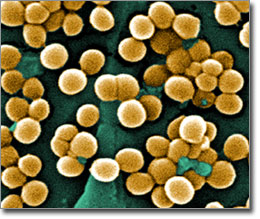
CDC/Janice Haney Carr
This 2005 scanning electron micrograph depicts clumps of methicillin-resistant Staphylococcus aureus bacteria. Magnified 9560x.
[The presence of a clear link between factory farms and human cases of the pig-linked MRSA ST398 strain] depends on your standards of evidence. MRSA ST398 has been found colonizing pig farms and pig farmers in the US, Canada, and in the European Union. You can argue about how prevalent it is — it’s easy to cast doubt on whether it is common, because not very many studies have been done. But you can’t argue that it is there.
The argument over whether ST398 in pigs is causing MRSA disease in humans is more subtle. It definitely has in the Netherlands, though not often so far. Has it done so in the US? No one has done the microbiology to tell.
As for the food supply, McKenna says it’s theoretically possible to contract MRSA from meat.
If MRSA ST398 is in pork — it’s been found in Canada and Europe, but not here yet — then the issue is not eating the pork (as long as you cook it), but rather handling it. It is possible that you could handle raw pork, unthinkingly touch your eyes or nose, and colonize yourself.
McKenna, who is writing “Superbug: The Rise of Drug-Resistant Staph and the Danger of a World Without Antibiotics,” urges better testing and monitoring of MRSA and the outbreaks thereof, and cautions that, even if they are not yet shown to harm humans, resistant drug strains are still a matter of public concern.
McKenna also wrote a comprehensive primer for AHCJ to help educate reporters about MRSA and the surrounding issues.
Obama announces FDA officials, food safety plan
In his weekly address, President Barack Obama announced new FDA leadership and a new Food Safety Working Group in which the Departments of Health and Human Services and Agriculture work to organize food safety efforts across all levels of government.
There are certain things only a government can do. And one of those things is ensuring that the foods we eat, and the medicines we take, are safe and don’t cause us harm. That is the mission of our Food and Drug Administration and it is a mission shared by our Department of Agriculture, and a variety of other agencies and offices at just about every level of government.
The President called food-borne illness a “hazard to public health” and “unacceptable” and said new FDA officials would work with other agencies to prevent and contain outbreaks as part of the Food Safety Working Group.
This Working Group will bring together cabinet secretaries and senior officials to advise me on how we can upgrade our food safety laws for the 21st century; foster coordination throughout government; and ensure that we are not just designing laws that will keep the American people safe, but enforcing them. And I expect this group to report back to me with recommendations as soon as possible.
New FDA Commissioner: Dr. Margaret Hamburg
Experience: Nuclear Threat Initiative’s founding Vice President for the Biological Program; Assistant Secretary for Planning and Evaluation, U.S. Department of Health and Human Services; Commissioner of Health for the City of New York; Assistant Director of the National Institute of Allergy and Infectious Diseases of the National Institutes of Health.
New Principal Deputy Commissioner: Dr. Joshua Sharfstein
Experience: Baltimore Commissioner of Health; member of the Board on Population Health and Public Health Practice of the Institute of Medicine.
At the end of the address, President Obama also announced several specific policy changes.
As part of our commitment to public health, our Agriculture Department is closing a loophole in the system to ensure that diseased cows don’t find their way into the food supply. And we are also strengthening our food safety system and modernizing our labs with a billion dollar investment, a portion of which will go toward significantly increasing the number of food inspectors, helping ensure that the FDA has the staff and support they need to protect the food we eat.
Lax oversight, complex supply chains aid outbreaks
In the wake of recent food-borne salmonella outbreaks, Justina Wang of the Rochester Democrat and Chronicle found that a combination of a complex supply chain and lax federal oversight has allowed a steady stream of dangerous pathogens to slip into the food supply.
Given the complexity of today’s food processing and distribution networks, Wang found that many health experts don’t see an end to the outbreaks.
“Absolutely it will continue to happen until big changes are made,” said Sanford Miller, former director of the FDA’s Center for Food Safety and Applied Nutrition and a senior fellow at the University of Maryland. “The food industry has just exploded over the last several decades, and unfortunately, the FDA has not been able to keep up with this.”
Pathogens can lurk in food for months and by the time someone becomes ill and is tested and diagnosed with a potentially dangerous food-borne illness, officials said, the outbreak may already be in full swing. Once the outbreak is detected, even more time passes as product recalls are put into place.
Related:
- Fatal Food: A study of illness outbreaks: Thomas Hargrove of Scripps Howard News Service wrote about food-borne illness outbreaks in a 2007 article for AHCJ. He found that some states did a good job of diagnosing and tracking down the causes of outbreaks, while other states “are virtually blind in detecting outbreaks of food illness.”
- HHS’s new social media team focuses on outbreak