College football, sickle cell can be deadly combo

Jul. 25th, 2011 by Pia Christensen · Leave a Comment
Filed under: Hot Health Headline 

Rachel George, Iliana Limón and Shannon J. Owens of the Orlando Sentinel look at college football players whose deaths have been linked to sickle cell trait.

Overwhelmingly in the past 11 years, more non-traumatic football deaths have occurred from complications from sickle cell trait than any other cause. It has accounted for nine of the 21 non-traumatic deaths in that time despite the trait existing in just 8 percent of African-Americans. It accounts for an even lesser extent in Hispanics, Caucasians and other ethnicities. And while the trait has been linked to deaths in other sports and at other levels, it has affected a much greater number of college football players.

Many doctors, coaches and trainers wonder what factors push a “generally benign” trait into a dangerous medical condition. George outlines some of the factors, such as coming back to training after a break, the kinds of drills athletes do, heat and hydration, altitude and more.

In the stories, doctors, coaches and former players discuss why football accounts for 82 percent of the cases in the U.S. National Registry of Sudden Death in Athletes.

The story includes NCAA materials about sickle cell trait and a graphic of the difference between normal blood cells and sickle cells. In a related story, Owens reports that “every baby in the United States is tested for sickle cell trait at birth, many athletes who’ve had it either didn’t know or didn’t understand what it meant.” In another story, she talks to parents of a child born with sickle cell trait who say they didn’t get information about the potential fatal complications.

The pitfalls of made-for-media scientific research

Feb. 11th, 2011 by Andrew Van Dam · 1 Comment
Filed under: Health journalism, Studies 

In our archive, you’ll find plenty of discussion about how the rhythms and demands of the newsroom impact media coverage of science, but what about the other side of the coin?

lombardi-trophy

Photo by youraddresshere via Flickr

What about those odd times when it appears that scientific researchers and publishers time their releases to get the most attention from the mainstream media?

When that question was begged by the overwhelming attention given to a study of heart attacks during two 1980s Superbowls that just happened to be released in time for this year’s big game, “Dr. Wes” Fisher examined the study on his blog. In this case, it seems, a well-timed news hook by the study’s authors may have triumphed over solid research. As an anecdote for all the unquestioning, “will-ya-look-at-this!” headlines, Fisher offers a quick laundry list of the study’s shortcomings:

  • Selection bias
  • Contamination bias
  • Co-intervention bias
  • The use of diagnosis codes culled from death certificates

(Hat tip to R. W. Donnell)

Online guide focuses on covering medical studies

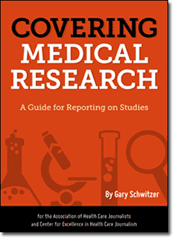
Covering Medical Research

Reporters are inundated with lures to cover the latest medical study or scientific conference paper. And there are some significant milestones being reached in medical research. But, more often, the information reaching the public is way too preliminary or even misleading, say those behind a new AHCJ reporting guide on covering health studies.

The guide will help journalists analyze and write about health and medical research studies. It offers advice on recognizing and reporting the problems, limitations and backstory of a study, as well as publication biases in medical journals and it includes 10 questions you should answer to produce a meaningful and appropriately skeptical report. This guide, supported by the Robert Wood Johnson Foundation, will be a road map to help you do a better job of explaining research results for your audience.

Researchers surprised by concussion study

Writing for Sports Illustrated, David Epstein tells the story of a small-scale Indiana football concussion study in which in which the youth in the control group unexpectedly became the headliners. The researchers were using functional MRIs and the popular ImPACT test, along with helmet-mounted accelerometers, to figure out what sort of hits cause concussions and how the consequences of such hits vary.

helmet

Photo by Les_Stockton via Flickr

Their first discovery? That “no particular magnitude of hit correlated with a concussion.” In fact, the youth they studied were suffering from very few concussions. It wasn’t until they started testing the unconcussed youth, as a sort of control, that they started seeing the results that have come to define their study, the full text of which is available online. Epstein again:

Of those eight [unconcussed youth], four nevertheless showed significant declines in visual memory. In fact, the players with the most impaired visual memory skills were not coming from the concussed group but from a group that in the week preceding the test had taken a large numbers of hits—around 150—mostly in the 40 to 80 G range

If the test scores were accurate, the researchers had inadvertently documented, in real time, a new classification of high school athlete: a player who was never concussed, was not verbally impaired and was asymptomatic even as far as his parents could tell, but whose visual memory was more impaired than his amnesic, headachy, light-sensitive, concussed teammates.

Researchers discovered one other surprise: The players who were asymptomatic but had impaired visual memory had suffered hits to the upper forehead, “which houses the dorsolateral prefrontal cortex – where linemen get hit, play in and play out,” as opposed to the heavy hits to the side of the helmet that most of us associate with concussions.

It’s a very small-scale study – only 21 boys completed the study conducted over one football season – but the researchers are expanding their work this season. Nevertheless, Epstein indulges in some speculation:

Consider this: Concussions as we know them involve a hit that rattles a part of the brain involved in language processing or motor skills. Hits to the forehead that might be every bit as damaging hide their nefarious effects in the frontal lobe, a part of the brain primarily involved in visual memory, planning and cognition, rather than motor or sensory function, and thus not taxed by sideline concussion exams. Indeed, it’s possible that all along, while brain trauma questions have focused on concussions, the real damage is being inflicted by minor impacts that chip away at the brain.

In another piece in Sports Illustrated, Peter King looks at recent violent hits in the National Football League that have attracted attention, the NFL’s attempts to make the game safer and the fans’ and players’ attitudes about the game.

Online guide focuses on covering medical studies

Covering Medical Research

Reporters are inundated with lures to cover the latest medical study or scientific conference paper. And there are some significant milestones being reached in medical research. But, more often, the information reaching the public is way too preliminary or even misleading, say those behind a new AHCJ reporting guide on covering health studies.

The guide will help journalists analyze and write about health and medical research studies. It offers advice on recognizing and reporting the problems, limitations and backstory of a study, as well as publication biases in medical journals and it includes 10 questions you should answer to produce a meaningful and appropriately skeptical report. This guide, supported by the Robert Wood Johnson Foundation, will be a road map to help you do a better job of explaining research results for your audience.


As school starts, so do youth sports injuries

The University of Michigan’s new Michigan NeuroSport Concussion Program seems to be cropping up everywhere, and as far as I can tell, it’s all part of a coordinated effort by the University. They already claim to have one of the only pediatric sport programs in the country, and now they’re expanding it with a clinical and research focus on “neurological sports injuries.”

In related news, the latest CDC Morbidity & Mortality Weekly Report includes an analysis of the numbers for “Heat Illness Among High School Athletes” from 2005 to 2009. The study examined 100 schools and nine sports, and found that heat-related illness was most common in football, and that August was the worst month for such afflictions.

AHCJ has a rich pool of resources for journalists looking to report beyond the press releases on stories like these, including:

Tip sheets
Concussions in young athletes
Reporting on sports injuries in school-age children
Health and education: Two intersecting beats
Health and education: Reporting resources
Blog posts
Tougher concussion rules from high school assn.
GAO evaluates youth concussion databases
Concussion more likely when hit is unexpected (Youth hockey study)
Attention focuses on football’s neurological effects
AP story: Hundreds of PTSD soldiers likely misdiagnosed

Concussion-related trauma masquerades as ALS

Aug. 18th, 2010 by Andrew Van Dam · Leave a Comment
Filed under: Hot Health Headline 

The New York TimesAlan Schwarz reports on what he says is “the first firm pathological indications that brain trauma results in motor-neuron degeneration.” The headline behind that conclusion, of course, is that researchers say some  athletes with concussion and impact-induced brain injuries may have been misdiagnosed as ALS victims.

helmet

Photo by peterjr1961 via Flickr

In interviews, the study’s authors even speculate that Lou Gherig, who gave the disease its popular name, may have instead suffered from a similar disease caused in part by brain injuries.

The finding was not unexpected, given that ALS seemed to occur at much higher rates in concussion-heavy populations like athletes and soldiers.

Schwarz’s summary of the study:

Doctors at the Veterans Affairs Medical Center in Bedford, Mass., and the Boston University School of Medicine, the primary researchers of brain damage among deceased National Football League players, said that markings in the spinal cords of two players and one boxer who also received a diagnosis of A.L.S. indicate that those men did not have A.L.S. at all. They had a different fatal disease, doctors said, caused by concussionlike trauma, that erodes the central nervous system in similar ways.

It’s in the emergence of that second disease that really seems to have attracted Schwarz’ attention. It behaves similarly to ALS, but shows a distinct protein pattern that only seemed to emerge in patients with a history of head injury. There is not, however, a 1:1 relationship. Other factors seem to also be at play, Schwarz writes.

Gary Schwitzer of HealthNewsReview.org examines the story more closely and concludes that, while this is an “important and fascinating area of research,” the story “did not exhibit the best of health/medical/science journalism.” He lists seven points of criticism and includes comments from one of the site’s medical editors.

John Gever of MedPage Today offers more scientific coverage of the study and points out that there was no mention of Gehrig in the study but that “a New York Times reporter coaxed McKee into suggesting that Gehrig may have been among those misdiagnosed – even though, as a first baseman, he did not routinely experience violent collisions. (He was, however, beaned at least twice during his 14-year career with the New York Yankees.)”

NFL to post concussion warning in locker rooms

Aug. 5th, 2010 by Andrew Van Dam · Leave a Comment
Filed under: Hot Health Headline 

In The New York Times, football concussion reporter Alan Schwarz examines the content and ramifications of a new warning poster the NFL will be putting in every locker room. An image of the poster can be seen here.

high school tackle

Photo by Eagle102.net via Flickr

The poster lists symptoms that players should look out for, including headaches, confusion, memory problems and feeling more emotional, and warns them not to ignore symptoms.

In addition to strictly medical information — including the most starkly worded warnings yet from the league — the poster reminds players that concussions can also have long-term negative impacts on their families and on the health of those youngsters who idolize pro athletes.

Greg Aiello, a league spokesman, said in an e-mail message that the poster, spearheaded by the league’s new head, neck and spine medical committee and written in collaboration with the players union and the Centers for Disease Control and Prevention, “is intended to present the most current and objective medical information on concussions and will be distributed to the players and clubs in the near future.”

Attention focuses on football’s neurological effects

Feb. 5th, 2010 by Andrew Van Dam · Leave a Comment
Filed under: Hot Health Headline 

Friday Night Lights author Buzz Bissinger, writing in Time, looks at two things he claims are being overlooked during the most recent uproar over football injuries: High school athletes and spinal injuries. Bissinger has strong opinions and two anecdotes, one of which includes a source who said that roughly two Texas high school football players suffer catastrophic spinal injuries each year.

stadium
Photo by julio cesar via Flickr.

Bissinger praises Alan Schwarz’ work on concussions at The New York Times, but openly doubts whether the advances Schwarz is helping force at the professional level will ever translate to high school.

I know the focus will not trickle down to where it is needed most: the high school level. Research has shown that young players are far more susceptible than older ones to serious injuries. …

There should be an ambulance at every high school game. There should be trainers. But don’t bet on it, as school districts cry a lack of money. Kids will continue to suffer serious head injuries. Kids will continue to become paralyzed because they never learned how to properly tackle, with their heads up. The game’s violence will continue because that’s exactly why we like it, our gladiatorial lust still intact 16 centuries after the Romans. The bigger the hit, the greater the roar.

Not a new concern

In an Op-Ed piece in The New York Times, Deborah Blum, a professor of science journalism at the University of Wisconsin, writes about a warning published in The Journal of the American Medical Association that said the medical profession can no longer ignore that “There is a very definite brain injury due to single or repeated blows on the head or jaw which cause multiple concussion hemorrhages” in a report about professional athletes.”

But what really makes the research and its conclusions so interesting is its timing: it appeared in The Journal of the American Medical Association on Oct. 13, 1928. This raises the question – at least for me – as to why we are announcing the athlete concussion-dementia link as a new, and still somewhat debatable, issue some 80 years later.

House Judiciary forum

Watch a video webcast of the Feb. 1 “House Judiciary Committee Forum on Head Injuries and Other Sports Injuries in Youth, High School, College and Professional Football,” or read about Republican’s reluctance to hold said forum in Houston.

Dan Rather report

Dan Rather’s latest investigative effort was a far-reaching look at concussions and football, with emphasis on both the high school and professional games. He frames it as part of the pre-Super Bowl concussion awareness push (PDF Transcript).

ESPN to air ‘Head Games’

ESPN reporter Greg Garber, on “Outside the Lines,” will look at the issue of concussions and the NFL at 8 a.m. ET on Sunday. Harold Donald Carson, a former linebacker and inductee into the Pro Football Hall of Fame, “has become one of the leading spokesmen for the NFL’s retired players. Passionate and eloquent, he is in some ways the league’s conscience on the subject.”

Carson, who played 13 seasons for the New York Giants, estimates he suffered about a dozen concussions during his career, but none of them were documented. While he believes concussions among former football players will escalate into an epidemic, Dr. Joseph Maroon, the Steelers’ neurosurgeon for nearly three decades and a member of the NFL’s concussion committee for the past three years, disputes that:

“Because we know that there are millions of high school kids, college kids, youth leagues, as well as other who play football annually, I think we are not seeing the epidemic at that level people are speculating about,” Maroon said.

Related

NYT’s Schwarz discusses football concussion beat

Jan. 7th, 2010 by Andrew Van Dam · 7 Comments
Filed under: Health journalism, Hot Health Headline 

For the Columbia Journalism Review, Brent Cunningham talked to The New York Times‘ Alan Schwarz about his work as the nation’s leading (and probably only) full-time football head injury reporter. Schwarz, whose work covering concussions brought him to the Times in 2007, talks about how he got started on the beat and how his work has impacted the sport as a whole.

It’s all interesting stuff, especially when he discusses how his background in mathematics has helped him report on sports injuries and medicine, but the real payoff comes when Cunningham finally  gets Schwarz to divulge his personal stance on concussions in youth football. It’s a crystallization of all Schwarz has learned, as well as a delicate balancing act between his personal and professional ethics.

high school tackle

Photo by Eagle102.net via Flickr

CJR: Let’s assume for a minute that your son, who you said is three years old, is actually ten years old and he is clamoring to play Pop Warner football. Would the fact that you would then have to decide disqualify you from covering the story?

Schwarz: No, it wouldn’t disqualify me, though of course that’s up to my editors. But there is something about working here—and I’m not saying we’re better than everyone else, blah, blah, blah—but there is something that really inspires you to do the right thing, and to do the thing that helps you to cultivate the trust that allows readers to take you seriously. So I would probably let him play because if I didn’t it would compromise the reporting. It would compromise the trust that others and even the league may have in me. Now, I would not send him out to slaughter, but getting one concussion is not that big of a deal—it just isn’t. And to suggest otherwise is incredibly irresponsible. So if my kid gets one concussion then yeah, he doesn’t play anymore probably. But to not allow him on the field is, frankly, an overreaction. And if I didn’t allow him to play then yeah, it would be harder to cover the story, if only in my own mind. I believe that the cost to others of my not being able to cover this story as well would be greater than the cost of my kid getting one concussion and never playing again. I’m a very mathematical guy. I follow certain precepts. And those are the things that make sense to me. And I can’t tell my kid he can’t play, because then what am I going to tell the league? What am I going to tell my editors? It doesn’t work. It’s dissonant.

Related

House holds hearing on brain injuries in NFL

Oct. 28th, 2009 by Pia Christensen · Leave a Comment
Filed under: Government, Hot Health Headline 

The House of Representatives is holding a hearing on “Legal Issues Relating to Football Head Injuries” that is being webcast on C-SPAN.org.

The witness list includes NFL commissioner Roger S. Goodell as well as the director of the players association, team executives, doctors, neurologists, retired players, families of former players and safety advocates.

Related

The New York Times: NFL Data Reinforces Dementia Links

NCAA doesn’t monitor painkiller use

Oct. 9th, 2009 by Andrew Van Dam · Leave a Comment
Filed under: Hot Health Headline 

Gene Sapakoff of the Charleston, S.C. Post and Courier reports that while the NCAA and the Atlantic Coast Conference went to the mat this summer over bagel quality in relation to an “ACC rules proposal seeking to specify ‘that an institution may provide fruit, nuts and bagels to student-athletes at any time,’” collegiate sports’ governing body doesn’t have any system in place to track or regulate the injections and painkillers given on a regular basis to many student-athletes.

ncaainjury

Photo by Monica’s Dad via Flickr

…the NCAA wouldn’t know if a South Carolina or Clemson player received one Toradol shot or 30 last week, or if a given school under its wide jurisdiction was refilling infamously addictive OxyContin and Vicodin prescriptions by the shovelful.

“The NCAA does not monitor that from a national standpoint,” said Mary Wilfert, the NCAA’s Associate Director of Health and Safety. “That is left to the institutions and also left to those professional and legal and ethical regulatory bodies that folks in those fields operate under.”

The NCAA sources Sapakoff consulted said that monitoring painkillers and other drugs given to student-athletes, while a good idea, would be a “gargantuan task” beyond the association’s resources.

“Just way too much to try and get a handle on. Simple as that, unfortunately,” said an NCAA official, requesting anonymity. “We just don’t have the staff as it is.”

Sapakoff’s series on painkillers in football also looked at high schools and the NFL.

Next Page »