Site lists hundreds of potential freelance outlets
Biotechmedia.com bills itself as a “marketing resource site for the medical, pharmaceutical, biotech and veterinary industries,” but AHCJ member Eileen Beal points out that it’s also a fantastic reference for freelancers. On the site, you’ll find hundreds and hundreds of health-related trade publications and journals, from “Cosmetic/Personal Care Packaging” to “Lab Automation & Robotics.” Savvy writers will see potential outlets everywhere on the page.
At the very least, the site’s worth a quick scan, if only to get a better impression of just how many health-related publications are out there. Biotechmedia’s descriptions of each publication tend toward “here’s how much you’d pay for a subscriber list,” but the links and titles alone are enough to broaden horizons and generate ideas.
The case for freelancing with trade publications
Health Journalism 2010 attendee L. Michael Posey, R.Ph., is editorial director of periodicals at the American Pharmacists Association, as well as a graduate student in the University of Georgia Health and Medical Journalism Program. On his blog, Oconee County Health Beat, Posey explains to journalists both why they should want to freelance for trade publications and how to go about doing so.
Related
Directory of freelance health journalists - AHCJ members can be listed in this directory for free. Editors are encouraged to use it to find the right person for their assignment.
Slow-to-pay insurers may become national issue
Filed under: Health care reform, Health journalism, Hot Health Headline
For The News Journal of Wilmington, Del., Hiran Ratnayake dug through more than 100 complaints filed last year against the state’s insurers for undue delays in payment. In them, he finds some key anecdotes and little hope that companies’ responses would speed up in the future.
State law requires that claims be paid within 30 days, and at least three insurers who do business in the state were handed significant fines for a “pattern of delays.” Ratnayake tells the stories of patients whose claims have been approved but who have made dozens of calls when their insurance companies don’t receive payment and other tactics that appear to be intended to delay payments.
Furthermore, Ratnayake quotes an expert who predicted that “delays will become more frequent as more people become insured under the [health care reform] act.” The act does not address prompt payment regulations, Ratnayake reports.
In addition to his local reporting, Ratnayake used HHS Secretary Kathleen Sebelius’ speech at Health Journalism 2010 to provide national context.
Sebelius said recently that the federal government would engage in “hand-to-hand combat” with health insurers over problems related to policyholders’ plans.
Pronovost strategy influences Ore. infection data
Filed under: Health data, Hospitals, Public health
Prompted by Peter Pronovost’s keynote speech at Health Journalism 2010, The Oregonian’s Joe Rojas-Burke has been digging through the data on hospital infection rates to be released in accordance with an Oregon law that went into effect last year. The final statewide reporting date comes later this month, but The Oregonian has early results for 11 local hospitals.

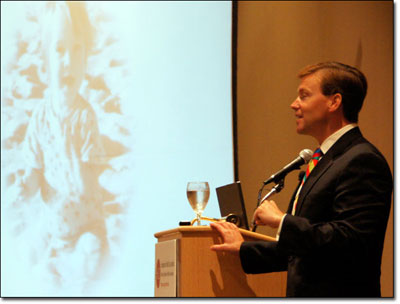
Peter Pronovost, M.D., delivers the keynote speech at Health Journalism 2010. (Photo: Pia Christensen/AHCJ)
As part of the story, Rojas-Burke profiled hospitals with particularly low infection rates, especially one which had joined the Stop BSI network championed by Pronovost last month at AHCJ’s conference in Chicago. AHCJ members can see a copy of Pronovost’s presentation here.
The story builds on several things Pronovost shared at the conference, including the program’s background and state-by-state participation statistics.
Related
Other stories and blog posts related to Pronovost’s presentation:
- The Checklist and Future Culture of Medicine, Medical Lessons
- Hospitals slow to adopt renowned program, The Lund Report
- Hospital infection rates, a deadly problem, KSMU-FM
AHCJ members can read more stories from the conference
Members provide more coverage of #ahcj2010
A number of AHCJ members volunteered to write about Health Journalism 2010 for AHCJ.

Many others used information they learned at the conference to write stories for their own publications.
We’re in the process of compiling those reports, as well as photos and video from the conference. Visit our conference news page to read more about the event.
Video from Health Journalism 2010
- During a newsmaker briefing, HHS Secretary Kathleen Sebelius discussed the role of health journalists in communicating about the H1N1 pandemic and health reform to the public.
- In a panel about “Guidelines for writing about preventive health guidelines,” Len Lichtenfeld, M.D., M.A.C.P., deputy chief medical officer for the American Cancer Society, acknowledged the difficulty of conveying changing guidelines.
Coverage from Health Journalism 2010
- Contaminated foods post threat to public
- Experts acknowledge difficulty of writing about preventive health guidelines
- TBI, PTSD among war-related illnesses veterans face
- Untold stories remain in nursing homes
- Addressing racial and ethnic disparities
- High hopes, limited regulation a dangerous formula for ‘functional foods’
- Looking for docs in all the wrong places?
- Caring for aging population will require health care transformation
- Sebelius predicts ‘hand-to-hand combat’ on health law
- What did the U.S. learn from the H1N1 pandemic?
- Experts: Where you live affects your health
- Journalists encounter obstacles in identifying conflicts of interest in medical research
- Session focuses tracking health care costs using the Dartmouth Atlas of Health Care
- Photos from Field Trip 1, at the simulation center at Feinberg School of Medicine
Coverage of #ahcj2010 continues
• Sebelius predicts ‘hand-to-hand combat’ on health law
• What did the U.S. learn from the H1N1 pandemic?
• Journalists encounter obstacles in identifying conflicts of interest in medical research
• Experts: Where you live affects your health
• Session focuses tracking health care costs using the Dartmouth Atlas of Health Care
• Photos from the simulation center at Feinberg School of Medicine
#AHCJ2010 early coverage roundup
Filed under: Government, Health care reform, Health journalism, Health policy, Hot Health Headline, Member news
Apart from the announcement of the FDA’s infusion pump regulation push, the biggest appearances out of Health Journalism 2010 in Chicago this week have been U.S. Department of of Health and Human Services Secretary Kathleen Sebelius and Thomas Frieden, director of the Centers for Disease Control and Prevention.
Landon Hall, of The Orange County Register, covered the Sebelius and Frieden appearances for AHCJ.
At Health Journalism 2010, Kathleen Sebelius talked about implementing health care reform. (Photo: Pia Christensen)Reuters’ Debra Sherman also covered both presentations.
Sebelius focused on insurers, especially those who deny coverage to those with a legal write to it, Sherman wrote. According to Sherman, “Sebelius… said to expect ‘hand-to-hand combat’ if insurers try to ‘drive patients out of plans.’”
Working from a broader perspective, New America Foundation’s Joanne Kenen wrote about how insurance fit into Sebelius’ larger task of implementing recently passed health care reform measures.
In his presentation, Frieden focused on smoking, which he called the leading preventable cause of death. Reuter’s Sherman again:
Dr. Thomas Frieden, director of the Centers for Disease Control and Prevention, said that after years of steady declines in the nation’s smoking rates, progress has stalled over the last few years and that the agency was renewing its focus.
He said government stimulus funds would be used to increase anti-smoking efforts. He said the CDC would encourage states to implement anti-smoking strategies, such as education and media campaigns, smoke-free laws and higher cigarette prices.
In other AHCJ 2010 news, Dallas Morning News reporter Robert Garrett wrote that a “siege mentality was very much on display when a trio of hospital executives spoke this morning at an Association of Health Care Journalists conflab in Chicago.”
“We’re all scared to death by health care reform,” said Advocate Health Care president and CEO Jim Skogsbergh, who runs 13 hospitals in Illinois. “We know we’re going to get paid less.”
FDA steps up regulation of infusion pumps (#AHCJ2010)
Filed under: Health journalism, Health policy, Hot Health Headline
Infusion pumps, a widely varied class of devices which typically mete out precise, time-delayed doses through IVs and related means, have been associated with 56,000 adverse events and more than 500 deaths in the past five years, Dr. Jeffrey Shuren told journalists assembled at Health Journalism 2010 this morning. Shuren is head of the FDA’s devices center. The malfunctions are often caused by hardware and software issues, and can lead to overdoses and other harmful events.
Photo by Felix42 via Flickr.NPR health blogger Scott Hensley, who was there for Shuren’s presentation, wrote that the FDA appears determined to take action to improve the pumps, which are almost ubiquitous in American hospitals.
The “widespread problems we are seeing warrant” prompt action, Dr. Jeffrey Shuren, head of the FDA’s devices center, told a meeting of the Association of Health Care Journalists in Chicago.
The agency will require design improvements, more thorough testing, and inspections of the infusion pump makers’ facilities before the devices are allowed on the market.
- PDF of Shuren’s presentation
- Related FDA press release
- AHCJ’s extensive list of other resources for covering the breaking infusion pump story
- Additional news coverage of Shuren’s announcement
NewsPro issue on AHCJ, health journalism (#ahcj2010)
Filed under: Health journalism, Hot Health Headline
NewsPro has once again turned the spotlight toward health journalism and AHCJ, just in time for Health Journalism 2010 in Chicago. Find a PDF of the full issue here, or go to the issue’s online index.
In addition to profiles of AHCJ award winners, highlights include:

- A preview of the main attractions at Health Journalism 2010.
- A “state of health care journalism in 2010” round-up that focuses on the double-edged sword of a reform debate that brought health to the forefront, yet carried with it partisanship and misinformation. The issue also includes a piece on reporters’ struggles to understand and communicate the debate’s issues.
- An argument that “In the arena of iPhone apps, there is perhaps no division attracting as much attention as health care.”
- An interview with Nancy Snyderman, the well-known doctor and television reporter.
- A lead story on how the Internet is passing television as “most essential medium in the lives of Americans.”
- An exploration of the ethical and practical dilemmas facing doctor-journalists in Haiti, and a companion survey of members of the National Association of Medical Communicators. The issue also includes profiles of a few prominent doctor-reporters.
- An attempt to address questions raised by the H1N1 epidemic.
Read our post on last year’s issue here.
Patient safety expert Pronovost is keynote speaker
Peter Pronovost, M.D., Ph.D., a professor at Johns Hopkins University and founder of the Quality and Safety Research Group, will be the keynote speaker at Health Journalism 2010. He will appear at the awards luncheon on Saturday, April 24.

Peter Pronovost, M.D., Ph.D.
Pronovost specializes in improving patient safety through methods that are scientifically rigorous but feasible at the bedside. In his new book, “Safe Patients, Smart Hospitals: How One Doctor’s Checklist Can Help Us Change Health Care from the Inside Out,” Pronovost tells of losing his father as the result of a medical error and his own journey from a researcher to an international leader in patient safety.
Pronovost joins a number of high-profile speakers. Conference participants will have the chance to attend newsmaker briefings featuring leaders from the Department of Health and Human Services, the Centers for Disease Control, the Food and Drug Administration:
- Thomas Frieden, M.D., M.P.H., director, Centers for Disease Control and Prevention
- Kathleen Sebelius, M.P.A., secretary, U.S. Department of Health and Human Services
- Jeffrey Shuren, director, Center for Devices and Radiological Health, Food and Drug Administration
A special track on assessing health reform is intended to help reporters understand the changes coming and better explain what’s ahead to their readers, viewers and listeners:
- Does comparative effectiveness research work?
- Outlook for the nation’s hospitals
- Is there a looming doctor shortage?
- What’s ahead for state and local governments
- The reporting challenge going forward
“Influenza! Lessons learned from a year of H1N1″ will feature experts on public health, infectious diseases, preparedness and vaccines:
- Jeffrey Levi, Ph.D., executive director, Trust for America’s Health
- Anne Schuchat, M.D., director, CDC’s National Center for Immunization and Respiratory Diseases
- Litjen Tan, Ph.D., director of medicine and public health, American Medical Association; co-chair, National Influenza Vaccine Summit
- Moderator: Maryn McKenna, independent journalist, Minneapolis
See the complete conference schedule.
Conference will deepen knowledge of health issues (#ahcj2010)
A list of expected sessions for Health Journalism 2010 has been released and it includes panels and classes on the most timely health topics.
The conference, April 22-25 in Chicago, will feature sessions about finding and using health data, as well as how to map it, on Thursday.
Field trips to see research and clinical work in the Chicago area are also planned for that day.
Panels on Friday, Saturday and Sunday will help reporters who are interested in tracking stimulus spending, understanding medical studies, comparative effectiveness research, conflicts of interest in medical research, vaccines, health reform, veterans’ issues, seniors and nursing homes and much more.
Conference registration for journalists is just $150 ($99 for students) and AHCJ negotiated a hotel rate of $139 at the Hyatt Regency McCormick Place, the conference hotel. A number of fellowships will be offered as well.
For those of you on Twitter, the hashtag #ahcj2010 has been designated for news about and from the conference. Follow AHCJ_Pia for all of the latest news from AHCJ.