NEJM article: Media partially to blame for slow adoption of cost-effective health care

May. 20th, 2011 by Pia Christensen · 5 Comments
Filed under: Health care reform, Health journalism 

In a new “Perspectives” piece in the New England Journal of Medicine, Victor R. Fuchs, Ph.D., and Arnold Milstein, M.D., M.P.H., examine why cost-effective health care has been slow to catch on in the United States.

They point to a number of factors, including insurance companies’ desire to protect profits, large employers that don’t want to alienate employees, legislators who collect campaign contributions from the health industry, hospital administrators protecting their revenue, doctors who are generally resistant to change, manufacturers that fear losing market share and more.

The authors also point blame at the media, saying it doesn’t adequately explain who really pays for health care:

Great harm is done when employment-based insurance is discussed as if it were a gift from “generous” employers rather than an alternative to wage increases.

They also mention a topic that is surely familiar to Covering Health readers: relative risk vs. absolute benefit.

The media also mislead the public by emphasizing the relative benefit of clinical interventions (“reducing risk of death by one third”) when the absolute benefit (“reducing risk from 0.03 to 0.02”) is usually more relevant.

“Misleading headlines, designed to attract larger audiences,” also get a share of the blame.

What do you think? Does media coverage have an effect on how cost-effective care is accepted? If so, do you have suggestions on what reporters could do differently?

Court ruling opens door for reporting on new law

Melissa Preddy of the Donald W. Reynolds National Center for Business Journalism followed up on Monday’s court ruling that part of the federal health care reform law is unconstitutional.

supreme-court

Photo by dbking via Flickr

Preddy puts the ruling in perspective and includes background about other lawsuits in the works. She also offers a number of story ideas to help reporters explain how the new law will affect their audience as well as some interesting stories to look at when planning your coverage.

Preddy even shares how her premiums have increased and how her insurer shared the news with her - the company attributed the higher costs to the mandates of the health care law.

For lots more ideas from journalists on the front lines, be sure to see these AHCJ resources:

Briefing: Reporting on health reform going forward

A briefing with some top Washington, D.C.-based reporters on Thursday at 12:15 p.m. ET should help reporters and editors around the country plot out how to cover health reform for the rest of the year and on to 2014.

After an intense year of covering health reform, the subject now seems more complicated than ever. Implementation timelines go on for page after page. Many questions seem to have no answers, at least not yet. Participants will discuss implementation deadlines, how to tie local issues to reform, how to coordinate coverage between D.C. bureaus and beat reporters at home and more.

The event, co-sponsored by the Alliance for Health Reform and the Robert Wood Johnson Foundation, will be at the National Press Club, you can participate from anywhere via teleconference and e-mail. Be sure to join us at 12:15 p.m ET by calling 888-205-6705 and using passcode 9493486. To submit questions before or during the briefing, e-mail them to info@allhealth.org

Health Reform: What's Next?

Related:

Upcoming chapter events will help journalists tackle the questions about what comes next and how the new law will affect people in their areas:

Journalists based in the D.C. area are invited to a June 15 meeting of AHCJ’s local chapter with the press office staff from the Centers for Medicare and Medicaid Services and White House Office on Health Reform. CMS and White House officials will discuss how reporters can get information on Medicare and Medicaid and changes coming to the programs under the new health law.

And, on the West Coast, AHCJ’s San Francisco Bay Area Chapter will gather on June 16 to learn about what health reform means for Californians. Experts from the California HealthCare Foundation will look at how health care in the state will be affected in the months and years ahead.

•AHCJ member Rose Hoban recommends a web-based presentation from Pam Sliberman, the head of North Carolina’s Institute of Public Health about what happens now with health reform. Hoban says the presentation is dense, but “Incredibly useful in helping me plan the next few months of coverage.” You can download the Windows media file or find it on the organzation’s health reform resources page.

Medicine 3.0 lists 25 top health policy blogs

The list specialists over at Medicine 3.0, a blog hosted by Nursingassistantguides.com, have provided a quick rundown of 25 top health policy blogs, written by a healthy mix of “doctors, attorneys, journalists and politicians” and covering everything from the ethics to economics of health care policy.

The list does a decent job of providing a cheat sheet for those hoping to catch all sides of the reform debate, and notes familiar names like Health Affairs Blog, Medical Ethics Blog and The Health Care Blog while also spotlighting a few lesser-known outlets.

Why health costs in McAllen, Texas, resonate

Jun. 10th, 2009 by Scott Hensley · 2 Comments
Filed under: Health data, Health journalism, Health policy 

Let’s just say right from the start that Atul Gawande’s recent story in The New Yorker about runaway health costs in McAllen, Texas, is a tour de force of explanatory journalism.

There is, thankfully, still a lot of good journalism being committed in this country. So what made Gawande’s article spread like wildfire? Kaiser Health News rounds up some insights on the power of the piece and tips for reporters who’d like to do the same thing.

Make the abstract real. Gawande’s article cites lots of facts and figures but leads the reader through the health-cost thicket with concrete examples and personal stories. Gawande’s article makes “it so real that people who are elected public figures can talk about this issue to anyone they meet,” says Robert Blendon, a Harvard health policy prof.

Mine the data. University of Minnesota’s Gary Schwitzer says you can do it, too. “No matter where you live in this country, there is a story in the Dartmouth Atlas data” showing variations in health spending. The story “didn’t require breaking news, a new study or new data” to be powerful, Schwitzer says. “Health reporters spend too much time thinking about breakthroughs, cures and new stuff, and not enough on access, disparities and variations in policy.”

Remember balance. The Kaiser roundup also includes criticism of the article. “Even though a lot of what he said was true, there’s a lot that he didn’t say that would actually balance the story,” says E. Linda Villarreal, past president of the Hidalgo-Starr County Medical Society.

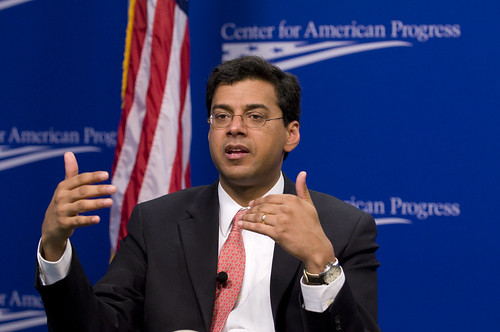
Dr. Atul Gawande, from Center for American Progress via flickr

Dr. Atul Gawande, from Center for American Progress via flickr

First chapters of latest sourcebook are online

Confused about covering health issues? The Alliance for Health Reform, a nonprofit that bills itself as nonpartisan health policy education group, is in the process of releasing a new guidebook for journalists who want background on the pressing matters of the day.

The 5th edition of Covering Health Issues: A Sourcebook for Journalists will eventually have 12 chapters online that tackle employer-sponsored coverage, individual coverage, children’s coverage, Medicare, Medicaid, long-term care, disparities, public health and mental health, among other things.

So far, three chapters are available: health reform, cost of health care and quality of care. The organization hopes journalists will find useful the various ‘fast facts;’ background information; story ideas; expert contact info; Web site suggestions; opinion polls and tips for understanding congressional budgeting and the appropriations process.

As with previous editions, the latest was funded with underwriting from the Robert Wood Johnson Foundation.