New data on insurance coverage released

Jun. 16th, 2010 by Andrew Van Dam · Leave a Comment
Filed under: Government, Health data 

The first full-year 2009 numbers about health insurance coverage from the NCHS’ National Health Interview Survey have been released. The notable numbers:

  • 58.5 million Americans were insured for at least part of the previous year
  • 46.3 million were without insurance at the time they were interviewed
  • 32.6 million had been uninsured for more than a year

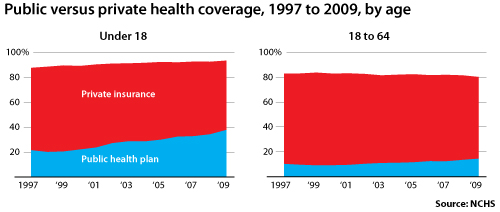
The numbers are sliced and diced a number of ways. I’ve included a visualization of one of the livelier categories: The number of people getting their health coverage from public or private sources.

nchs

Employers, insurers, consumers agree on COBRA

Jan. 12th, 2010 by Andrew Van Dam · Leave a Comment
Filed under: Hot Health Headline 

The Miami Herald’s John Dorschner looked into just how much of a hassle it is for laid-off employees to retain health coverage through the federal COBRA program. Along the way, he also noted that the program’s not popular with employers or insurers either.

Dorschner opens with an anecdote that shows just how broken the system is and illustrates the frustrations many are facing.

The Rosens’ case is an extreme example of something that’s happening frequently throughout South Florida: Laid-off workers are struggling through a difficult maze to keep health insurance while insurers and former employers have no interest in helping them beyond what federal and state laws require.

For employers, COBRA means unwanted paperwork and bureaucracy. For insurers, it means unwanted risk.

A key problem for insurers is that young and healthy employees who are laid off tend to reject COBRA, while older and sicker workers grab it. “Typically those who take COBRA coverage cost two to five times [[more] in benefits than a normal employee costs,” LeCompte says.

Despite its flaws, COBRA is seen to provide an important safety net, and the 65 percent federal subsidy for COBRA coverage has been extended to cover those workers laid off before March 1, 2010. Furthermore, the House version of the reform package, at least, has a provision saying that folks could retain their COBRA coverage at least until federal insurance exchanges begin sometime around 2013.

Census data on insurance coverage: The recap

The Census Bureau couldn’t have timed the release of its first American Community Survey data on health insurance coverage in America any better. Special interests and politicians alike have seized upon the data, and a wide variety of outlets have published analyses. NPR’s map breaking down coverage by state and political district is particularly interesting (To see other ACS results as well, try USA Today’s map).
acsquestion
In case you somehow missed the coverage, here are a few highlights from the data:

  • Fewest insured, overall: Texas (24.11 percent), New Mexico (21.44 percent), Nevada (21.33 percent), Florida (20.83 percent), Alaska (20.05 percent)
  • Most covered, overall: Massachusetts (95.88 percent), Hawaii (93.28 percent), District of Columbia (91.95 percent), Puerto Rico (91.39 percent), Minnesota (91.33 percent)
  • Under-18: Nevada, Texas and Arizona insure the fewest children, Massachusetts, Vermont and D.C. insure the most.
  • Medicare: New Mexico, Texas, D.C., Arizona and California had the most uninsured folks over the age of 65. They also have some of the nation’s highest percentages of illegal immigrants.

If you’re still looking for local data, visit this page of the Census Bureau’s American FactFinder, sort by state, county, district or other census designation, and pull up the relevant data. When the data comes up, choose “Print/Download” from the top menu, choose “Download” and choose to save it in Excel format. From there, the data’s fairly easy to clean and use, though the more detailed levels (such as county) may require a little tweaking.