Critically evaluate, report on cell phone/cancer link

Courtesy of the International Agency for Research on Cancer’s press release and the storm of advance coverage it has spawned, you’re probably already braced for Lancet’s imminent publication of the IARC’s report classifying “radiofrequency electromagnetic fields” as “possibly carcinogenic to humans,” otherwise known as the cell phone/cancer link.

txt
Photo by mallix via Flickr

While you’re waiting, it’s worth taking a few minutes to put yourself in position to critically evaluate the study. The six-page press release is a decent place to start, but as Dr. Len Lichtenfeld, blogger and deputy chief medical officer for the national office of the American Cancer Society, reminds us, IARC is a respected source, but the science they’re reviewing is tricky and, at this point, it’s just a press release.

For background on the scientific debate, see Lichtenfeld’s commentary and Eliza Barclay’s post on Shots, NPR’s health blog.

If you don’t have time for the full press release right now, I have pasted what I consider the two must-read paragraphs below. The first summarizes what the working group found upon reviewing established science, while the second explains exactly how the scientists are currently classifying the possible link between cell phones and cancer. Between the two of them, you get a quick snapshot of the study and its implications.

Results
The evidence was reviewed critically, and overall evaluated as being limited among users of wireless telephones for glioma and acoustic neuroma, and inadequate to draw conclusions for other types of cancers. The evidence from the occupational and environmental exposures mentioned above was similarly judged inadequate. The Working Group did not quantitate the risk; however, one study of past cell phone use (up to the year 2004), showed a 40% increased risk for gliomas in the highest category of heavy users (reported average: 30 minutes per day over a 10‐year period).

Group 2B: The agent is possibly carcinogenic to humans.
This category is used for agents for which there is limited evidence of carcinogenicity in humans and less than sufficient evidence of carcinogenicity in experimental animals. It may also be used when there is inadequate evidence of carcinogenicity in humans but there is sufficient evidence of carcinogenicity in experimental animals. In some instances, an agent for which there is inadequate evidence of carcinogenicity in humans and less than sufficient evidence of carcinogenicity in experimental animals together with supporting evidence from mechanistic and other relevant data may be placed in this group. An agent may be classified in this category solely on the basis of strong evidence from mechanistic and other relevant data.

For more perspective on what a 2B classification really means, see Katherine Harmon’s post on the Scientific American editors’ blog. Her key point is that “The May 31 announcement, however, doesn’t imply that cell phones cause cancer. It suggests that there are still enough unknowns not to rule out long-term health effects of the devices.”

Merrill Goozner expects the evidence to be murky and he concludes that IARC’s tenuous conclusion will be fully justified but also largely ignored by the public. He also points us to Lou Slesin’s Microwave News for solid reporting on the conflicts of interest surrounding the issue.

Finally, once the science is published and it’s time to file stories, be sure to refer to AHCJ’s guide to covering medical studies (membership required), where you’ll find all the tips and reminders necessary to ensure you’ve covered all the bases on this high-profile story.

Online guide focuses on covering medical studies

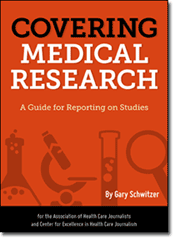
Covering Medical Research

Reporters are inundated with lures to cover the latest medical study or scientific conference paper. And there are some significant milestones being reached in medical research. But, more often, the information reaching the public is way too preliminary or even misleading, say those behind a new AHCJ reporting guide on covering health studies.

The guide will help journalists analyze and write about health and medical research studies. It offers advice on recognizing and reporting the problems, limitations and backstory of a study, as well as publication biases in medical journals and it includes 10 questions you should answer to produce a meaningful and appropriately skeptical report. This guide, supported by the Robert Wood Johnson Foundation, will be a road map to help you do a better job of explaining research results for your audience.

International cooperative to share health data

Writing that “the importance of data sharing in advancing health is becoming increasingly widely recognised,” 17 major public health players entities, from the CDC and AHRQ to the Bill and Melinda Gates foundation and the World Bank, have banded together to form a sort of data cooperative around the Wellcome Trust and the Hewlett foundation. In a Lancet commentary announcing the initiative, Wellcome director Mark Walport and Hewlett president Paul Brest write that, while fields such as genetics and molecular biology, a mature data-sharing system has sped up discoveries and increased efficiency, public health is lagging behind.

Much of the infrastructures, technical standards, and incentives that are needed to support data sharing are lacking, and these data can hold particular sensitivities. And some researchers are reluctant to share data. Too often, data are treated as the private property of investigators who aim to maximise their publication record at the expense of the widest possible use of the data. This situation threatens to limit both the progress of this research and its application for public health benefit.

Each organization will work within its own structure and their initial goals include the creation of data standards to facilitate sharing as well as increasing the prestige of creating public data sets. They acknowledge there will be some bumps along the way, but call on other organizations to join the initiative and to pursue the long-term goal of the widespread, fair and privacy-respecting sharing of public health data.

BMJ: Wakefield’s vaccine-autism study fraudulent

The Internet and other media are abuzz with the news, published by BMJ yesterday, that the study published in The Lancet in 1998 by Dr. Andrew Wakefield linking autism to the MMR vaccine was fraudulent. The study of 12 children is frequently cited as proof that vaccines cause autism or play a part in the disorder, despite the fact that it was retracted. The BMJ calls the study “fatally flawed both scientifically and ethically” in a new editorial.

Covering Health has compiled some links to interesting reading on this subject, much of it specifically for journalists.

Ivan Oransky, on Embargo Watch, looks at an entirely different facet of the news with “Does a tweet break an embargo? A case study involving the BMJ, autism, vaccines, and an alleged hoax.”

Meanwhile, Gary Schwitzer, publisher of HealthNewsReview.org, writes that the Wakefield MMR/autism dismantling demonstrates what a difference one journalist can make.

CNN’s Anderson Cooper interviewed Andrew Wakefield last night about the charges that his study was flawed. And Brian Deer, the investigative journalist who reported the BMJ story, was interviewed on CNN’s World Report.

Update: Seth Mnookin, who has spent two years looking into vaccine scares, has written an interesting post about the topic, including his view that BMJ over-hyped its story, which almost certainly helped drive media coverage. Mnookin also appeared on CNN.

By sending out breathless press releases and prepping the worldwide media for a series of bombshell stories, the BMJ created the impression that this was fundamentally new news – and it wasn’t. We knew that Wakefield’s work wasn’t reliable or accurate on January 3 – and we still know that today. The stories that are currently running are not really all that different in tone or content than the stories that ran almost exactly a year ago, when a UK medical panel found there was sufficient evidence to justify stripping Wakefield of his right to practice medicine.

Covering Health posts

Tip sheets

  • Background on autism from Pauline A. Filipek M.D., director of the Autism Program for OC Kids Neurodevelopmental Center and associate professor of clinical pediatrics and neurology at the University of California, Irvine, School of Medicine.
  • Investigating alternative treatments for autism: Trish Callahan & Trine Tsouderos, of the Chicago Tribune, wrote “Dubious Medicine,” a look at the world of alternative treatments for autism, treatments that are often risky and unproven.

Contest entries

Covering Medical Research

Covering Medical Research

Learn how to analyze and write about health and medical research studies with AHCJ’s latest slim guide. It offers advice on recognizing and reporting the problems, limitations and backstory of a study, as well as publication biases in medical journals and it includes 10 questions you should answer to produce a meaningful and appropriately skeptical report. This guide, supported by the Robert Wood Johnson Foundation, will be a road map to help you do a better job of explaining research results for your audience.

Journals pay for cracking down on industry funding

Paul Basken reports in the Chronicle of Higher Education that major medical journals, whose financial viability often depends heavily upon industry support, are faced with an “inherent conflict of interest” when it comes to filtering possible industry bias from their articles.

Basken’s report relies on an analysis of industry-funded studies presented at the International Congress on Peer Review and Biomedical Publication in Vancouver. Once the Journal of the American Medical Association introduced an independent verification requirement for industry-funded studies in 2005, Basken reported, it “saw the percentage of industry-supported studies in its pages drop 21 percent, from more than 60 percent of its published trials to 47 percent. Lancet, however, saw a growth of 17 percent, and The New England Journal of Medicine had an increase of 11 percent, the group reported.”

Lancet assesses Gates Foundation achievements

Jul. 15th, 2009 by Andrew Van Dam · Leave a Comment
Filed under: Hot Health Headline 

The journal Lancet tackled the Bill and Melinda Gates Foundation in a recent issue, assessing the heavyweight’s grants and spending. The study seeks to chronicle the foundation’s grants from 1998 to 2007 (a time period in which it handed out almost $9 billion), and the accompanying editorial provides a clear-eyed, critical review of the foundation’s work, transparency and priorities.

Some of the more striking numbers from a report full of them:

  • The $1.2 billion spent by the foundation in 2007 on global health alone rivaled the World Health Organization’s entire annual budget (some of which is, not coincidentally, itself provided by the Gates foundation).
  • Three quarters of global health funding went to “HIV/AIDS, malaria, vaccine-preventable diseases, child health,
    tuberculosis, and other tropical diseases and neglected
    diseases.”
  • The 1094 grants issued from 1998 to 2007 ranged from $3,500 to $750 billion.
  • Twenty organizations shared 65 percent of the foundation’s global health funding.
  • As a whole, NGOs and nonprofits got $3.3 billion while Universities got $1.8 billion. The rest went to other organizations and governments.
  • Administrative expenses totaled $264 million in 2007.

The report also breaks down Gates funding by geography:

In terms of the geographical location of primary recipients, $3·62 billion (40%) of all funding was awarded to supranational organisations such as global health partnerships and intergovernmental organisations. Of the remaining amount, 82% ($4·39 billion) went to recipients based in the USA, 13% ($0·70 billion) to recipients in Europe and other high-income countries (eg, Australia), and 5% ($0·24 billion) to recipients in low-income and middle-income countries.

(Hat tip to Rahul Parikh, who provides a particularly useful breakdown of the numbers involved.)