Exploring ethics, standards in science blogging
Filed under: Conflicts of interest, Health journalism
As a follow up to ScienceOnline 2011, independent journalist Maryn McKenna writes about bringing the standards of journalism to blogging.
At the annual meeting that brings together scientists, journalists, bloggers and others interested in communicating about science, McKenna took part in a discussion about ethics and credibility.
Regular readers of Covering Health will remember last year’s ScienceBlogs controversy as well as health journalist Mary Knudson’s decision to not blog for U.S. News & World Report when she noticed her first post had been studded with sponsored hyperlinks.
McKenna, who is a member of AHCJ’s board of directors, outlines how she has brought her own “best practices” to blogging and outlines them. She also highlights several points from AHCJ’s statement of principles that specifically deal with issues medical and science writers face.
Of course, as some people at the meeting noted, not everyone who blogs is – or wants to be – a journalist. But many of them do see the need for standards and transparency, as science writer Ed Yong points out. Science journalist Dave Mosher, of Wired.com, also explores the topic.
Catch up with the latest AHCJ member news
KMSP-Minneapolis investigative reporter Jeff Baillon earned two Upper Midwest Regional Emmy awards. “Where’s the Money,” a series looking at the financial collapse of a company owned by a former U.S. senator, won for investigative reporting. “Car Trouble,” a piece about a man imprisoned for killing three people in a car crash involving a Toyota Camry, also won. The story uncovered evidence which supported the driver’s claim that the accident was the result of “unintended acceleration.” The man has since been freed from prison.
Theresa Brown’s new book, Critical Care: A New Nurse Faces Death, Life, and Everything in Between, was published by Harper Collins in June.
Heather Chambers left the San Diego Business Journal for the California Healthcare Institute in June. She is serving as their writer – technically “communications specialist.”
Columbus Business First reporter Carrie Ghose’s health care beat coverage in 2009 won second place for business reporting among papers with less than 100,000 circulation in the 2010 Ohio Society of Professional Journalists Awards.
Carol Goldsmith, an anchor at WYFF-Greenvile, S.C., won a Peabody award for “Chronicle: Paul’s Gift,” an hour-long documentary on organ donation that goes from the hospital bed, to surgery for organ recovery, to the transplant recipients, and the meeting months later between the donor’s widow and the recipients. She was the co-anchor and co-producer for the project.
On Aug. 30th, Christine Gorman started work as the health/med/bio features editor at Scientific American, with a mandate to beef up its health and medicine reporting. She works in the print, online and mobile spaces. You can find her first health column in the October 2010 issue.
Terri Hansen won first place in the 2010 Native American Journalists Association’s Media Awards for “Best Environmental News Story.”
Andrew Holtz’s third book, House M.D. vs. Reality, will be published in early 2011 by Berkley/Penguin in the United States. He also has deals for Brazilian and Czech editions with other proposed editions pending. The bad news is that www.MDiTV.com, where Holtz was anchor & senior news editor, has suspended production of video news reports. Holtz continues to do reviews for www.HealthNewsReview.org and, along with Bill Heisel, occasionally fills in for Gary Schwitzer to coordinate the reviews.
Lisa Jaffe Hubbell has become a regular blogger at GE’s healthymagination.com health blog and is contributing to Today’s Hospitalist.
Chicago Tribune health care reporter Bruce Japsen has a new column answering readers questions specifically about the implementation of health reform.
Sandra Jordan is a winner of the American Cancer Society High Plains Division 2010 Media Awards competition in the Newspaper - Weekly Feature category for her story, “The New Age of Prostate Cancer.” Jordan is also a 2010 National Press Foundation fellow for the “Cancer Issues” seminar in Washington, D.C. in October. Chris King (managing editor) and Jordan (health reporter) shared honors with the rest of St. Louis American staff when it was recognized as best non-daily paper in North America (circ. greater than 37,500) of 2010 by Suburban Newspapers of America.
P. Mona Khanna, M.D., M.P.H., F.A.C.P., is the recipient of the American Medical Writers Association’s Walter C. Alvarez Award. The award honors excellence in communicating health care developments and concepts to the public.
Euna Lhee is now a multimedia health reporter for Florida Public Radio, as a part of the Healthy State Collaborative project. Based at WMFE in Orlando, Lhee reports on health care issues, biotechnology and medical research.
The Salt Lake Tribune’s Heather May was awarded a fellowship this summer through the USC Annenberg/The California Endowment Health Journalism Fellowship program. She will be writing about minority health disparities in Utah.
Maryn McKenna became one of the seven launch bloggers on Wired.com’s new invitation-only science-blog network.
Marilyn Nelson took part in the International Center for Journalists’ personal finance class, for which she completed a story project about American Indians and personal finance.
Tom Paulson curates a niche news site for KPLU as part of NPR’s new Argo project. His focus, based in Seattle, is on global health and development.
Peggy Pico has returned to her hometown of San Diego as the science and technology reporter at KPBS, where she does daily radio and weekly TV reports on the biotech industry.
Lisa A. Price, chief editorial adviser at Sound Integrated Health News, was featured in the Journal for Minority Medical Students (Vol. 22 No. 2), NCCAM Researcher Profile, Special Report for research on medicinal mushrooms and cancer.
Lee-Lee Prina, senior editor of GrantWatch at Health Affairs, is now managing the journal’s new GrantWatch Blog, which launched in March 2010.
Marilyn Werber Serafini has been selected as the inaugural Robin Toner Distinguished Fellow of the Kaiser Family Foundation. Serafini, who spent 19 years at National Journal, covered the U.S. Congress since 1985, writing about health care, tax, trade, welfare, pension and banking legislation. She covered the health reform debate during the Clinton Administration and the recent debate that led to the Patient Protection and Affordable Care Act. Serafini began her fellowship in August and is working closely with the editors of Kaiser Health News and KHN its partners on a series of articles on health policy and politics, as well as stories that explore the intricacies of health reform implementation.
Tampa Tribune consumer health reporter Mary Shedden won a SPJ Green Eyeshade Award, which recognizes excellence in 11 Southern states. She took first place in the category of “Public Affairs – Print – Daily.” Her entry, “Stuffy Nose? Tired? You may already have had swine flu,” included her body of work that aimed to help readers understand how to identify the flu’s symptoms and to protect themselves. Shedden also was a 2009 AHCJ-CDC Health Journalism Fellow.
Lorena Tonarelli’s new book, Caring - The Essential Guide, has been published by Need2KNow books.
Send us your latest news
Got a new job? Earned a promotion? Won an award or fellowship? Just published a book? AHCJ members are encouraged to share your news by sending it to info@healthjournalism.org. Member news items are published on Covering Health and in HealthBeat, AHCJ’s newsletter.
Whooping cough: Not just a problem for kids
Maryn McKenna, AHCJ board member and self-proclaimed “most vaccinated person on the planet,” writes about her own bout with whooping cough. She’d had her shots back in the day, but apparently whooping cough immunity conferred by childhood vaccines fades, and anyone over the age of 12 probably needs a booster.
This is relevant because, while whooping cough is not generally fatal to adults, it’s easily transmitted to more vulnerable folks. And in California and across the country, it’s on the march and vaccine supplies are limited.
The worst news in this upsetting trend is this: We’re doing it to ourselves. As far as anyone can tell, the rise in pertussis is not due to any change in the organism, or to any mysterious error among the manufacturers who make pertussis vaccines. It’s due to vaccine refusal, to parents turning away from vaccines because they think the vaccines are more harmful than the diseases they prevent — or, more selfishly, because they think the wall of immunity created by other vaccinated children will protect their unimmunized ones.
That wall of immunity, McKenna says, hasn’t been helping the unvaccinated kids, who are 23 times more likely to pick up the disease than their immunized peers.
The Texas Tribune’s Ben Freed learns, through conversations with public health experts, that the “entirely preventable” disease can be stopped with vaccination rates between 80 percent and 85 percent. Unfortunately, adult rates are nowhere close to those numbers, though the state is taking steps to increase adult vaccinations.
California officials are urging people to get vaccinated as that state has now seen a six-fold increase in whooping cough this year.
McKenna on A. baumanii, the latest resistant bug
On her Superbug blog, AHCJ board member Maryn McKenna works her explanatory magic on Acinetobacter baumanii, a drug-resistant bug whose profile (and incidence) is, in McKenna’s words, “rocketing.”
A. baumanii is a nasty bug, causing not just wound infections but pneumonia, urinary tract infections, meningitis and bacteremia. Even more nasty, it collects resistance factors like baseball cards, and is commonly resistant to at least 4 antibiotic classes.
To make the outlook even bleaker, the antibiotic development pipeline for A. baumanii’s class of bacteria has dried up and only super-toxic colistin can take out the nastiest strains of the bacteria. It looks like A. baumanii, whose resistant strains have spread explosively in the past decade, has a particular knack for spreading resistance.
The only real hope for containing A. baumanii, McKenna writes, may be cooperation between all the different local institutions in the fragmented American medical system.
Public health loses leading blogger
Revere, the pseudonym behind the leading public health blog EffectMeasure, has announced that (he/she/they) will be hanging up the tri-cornered hat and passing the baton to The Pump Handle. While we have nothing but respect for The Pump Handle’s work, it’s sad to see Revere go. Revere’s farewell post has already attracted 85 comments, and AHCJ board member Maryn McKenna posted a eulogy on her SuperBug blog:
For more than 5 years now, Revere (a collective voice of an unknown number of public health experts — for simplicity, let’s say “he”) has been a reliable, thoughtful, expert, humorous and deeply knowledgeable guide to the intricacies of public health and public health politics. … And though few would admit it, Revere’s posts have been consistent agenda-setters in newsrooms all across the planet; insiders knew that, if Revere said something, it would start showing up in newspapers and on wires about 12 hours later.
AHCJ members talk H1N1, grade the media
AHCJ member Dr. Mona Khanna and AHCJ board member Maryn McKenna , along with New Hampshire state epidemiologist Dr. Jose Montero and host Laura Knoy discussed H1N1 and the media on New Hampshire Public Radio Wednesday. Debate centered on the media’s performance thus far, as well as the role that it ought to play during an outbreak or pandemic.
A few salient points from their key exchange:
Montero started things off by saying that health care journalists will be critical to public health efforts and will be relied upon to inform the public and provide context.
McKenna gave the media a “C” grade for their performance to date, with the explanation that, after round upon round of layoffs, there may not be enough expert journalists left to fulfill the public health role envisioned by Montero. “All the people who would be counted on to know this subject … most of those people don’t work in the media anymore,” McKenna said. “You can’t count on the media any more as the people who can put the breaks on alarmism.”
Khanna agreed, saying that even experienced health journalists sometimes lack key scientific understanding and should consult with scientists or medical professionals.
McKenna talks about MRSA in pigs, farmers
In addition to the strains of MRSA that arose in hospitals and the community, there is one that seems to correlate pretty strongly with pig farmers and, in many cases, is present in both the farmers and their stock. Bonnie Powell, founder of The Ethicurian blog, interviewed journalist (and AHCJ member) Maryn McKenna about MRSA and the recent discovery in the Netherlands of a strain linked to commercial pork production.

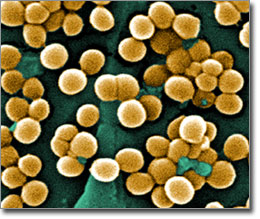
CDC/Janice Haney Carr
This 2005 scanning electron micrograph depicts clumps of methicillin-resistant Staphylococcus aureus bacteria. Magnified 9560x.
[The presence of a clear link between factory farms and human cases of the pig-linked MRSA ST398 strain] depends on your standards of evidence. MRSA ST398 has been found colonizing pig farms and pig farmers in the US, Canada, and in the European Union. You can argue about how prevalent it is — it’s easy to cast doubt on whether it is common, because not very many studies have been done. But you can’t argue that it is there.
The argument over whether ST398 in pigs is causing MRSA disease in humans is more subtle. It definitely has in the Netherlands, though not often so far. Has it done so in the US? No one has done the microbiology to tell.
As for the food supply, McKenna says it’s theoretically possible to contract MRSA from meat.
If MRSA ST398 is in pork — it’s been found in Canada and Europe, but not here yet — then the issue is not eating the pork (as long as you cook it), but rather handling it. It is possible that you could handle raw pork, unthinkingly touch your eyes or nose, and colonize yourself.
McKenna, who is writing “Superbug: The Rise of Drug-Resistant Staph and the Danger of a World Without Antibiotics,” urges better testing and monitoring of MRSA and the outbreaks thereof, and cautions that, even if they are not yet shown to harm humans, resistant drug strains are still a matter of public concern.
McKenna also wrote a comprehensive primer for AHCJ to help educate reporters about MRSA and the surrounding issues.
Prevention vs. treatment in global health
AHCJ members Christine Gorman and Maryn McKenna participated in a blog experiment, in which a group of people decide to blog about the same topic at the same time - similar to a blog carnival. The experiment, focused on global health and “prevention vs. treatment,” generated posts from a variety of viewpoints:
- Prevention vs. Treatment: A False Choice
- The gradual abandonment of anti-tobacco/anti-smoking programs in the U.S.
- Why we tend to value current health more than future health“
- The need for a vaccine against methicillin resistant staph aureus
- Why prevention vs. treatment is the wrong way to think about drug resistance to malaria
- Proving prevention works is a lot harder than you might think
- HIV Information for Myanmar offers a few words on the greater good from the late Bogyoke (General) Aung San, who led the fight for Burmese independence after World War II.
- Whether concerns over health reform in the U.S. will crowd out discussion of global health
- On why good decisions in public health “are about balance, and looking for long-term systemic solutions instead of the quick fix“
- And, from a public relations perspective: differences between ’selling-in’ stories that have a prevention angle over those that emphasise treatment“