House calls on the rise as their economic benefits become clear
Filed under: Aging, Health policy, Hospitals, Public health
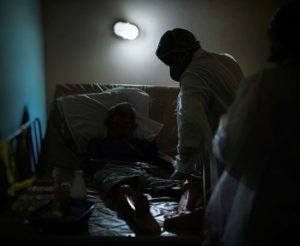
In The Miami Herald, Ana Veciana-Suarez looks into why doctor house calls are on the rise, especially among the Medicare set. Through her reporting, it becomes apparent that it’s primarily a function of economics, all driven by the fact that, while a house call may appear expensive when compared to a typical primary care visit, in many cases the real alternative to a house call and some preventative medicine is an emergency room visit and/or an overnight hospitalization, both of which are in another cost bracket entirely.
Veciana-Suarez writes that while the latest home care boom may have started with the growth of concierge medicine, especially in South Florida, it’s now being driven by the big guns — Medicare and major insurers.
House calls, once thought to be too time-consuming and not very cost-effective, are making a comeback as healthcare providers recognize that they’re actually the answer to good care for patients who can’t make it to a doctor’s office. Medicare-paid house calls have been steadily increasing, according to government figures, and doctors report the same for non-Medicare patients, according to the American Academy for Home Care Physicians. What’s more, technology has made accessibility to patients’ records and other medical information available at any time and any place, a boon to physicians on the go.
Now a three-year federal government pilot program called Independence at Home is encouraging doctors to pick up those black medical bags of yore and pay a visit to their sickest patients. As part of the new healthcare reform law, the demonstration project will cover 10,000 Medicare patients described as medically fragile. It is set to begin in January in locations yet to be decided.
The main targets for both the government and private insurance programs are the so-called “frequent fliers,” and others with chronic conditions that need to be managed to prevent repeat visits to the emergency room. To that end, some programs also include social workers and home health educators. Most programs are still in the experimental phase, but Veciana-Suarez paints a clear picture of a sector that’s poised to assume a growing role in the coming decade.
Reporter checks records, hits facility with news
of looming closure
Filed under: Health journalism, Hot Health Headline, Public records
After picking up new tools and techniques at Health Journalism 2011, reporter Sarah Bruyn Jones returned to The Roanoke Times and lost no time in putting it to use. Her story, on the impending closure of a local assisted living facility, came as a direct result of checking nursing home inspections. It also, if home operators are to be believed, came as a surprise.
Edward Jones, president of Ashed Healthcare Systems, which owns Monticello, said he was unaware of the state’s intentions to close the facility.
“I had no clue of any of this until you mentioned this,” Jones said when contacted late Thursday about the impending closing.
Thanks to the inspection records, Jones’ story is loaded with details like “Moldy bathrooms, poor plumbing, water leaks, crumbling walls, broken lights and roaches,” and a solid chronology of events.
At one point an inspector found that residents had been without toilet paper for at least two days. In July the building’s water was turned off because the owners had failed to pay the bill.
…
Patients were being given prescription medication when there was no record of a diagnosis for those drugs. In some instances, drugs that were supposed to be given weren’t being dispensed. A diabetic wasn’t receiving insulin. Another patient was only getting half the prescribed dose of medicine.Earlier this year two residents lost Medicaid coverage after the Monticello staff member assigned to file annual renewals for the residents failed to complete the work.
Slim guide:
Covering the Health of Local Nursing Homes
This reporting guide gives a head start to journalists who want to pursue stories about one of the most vulnerable populations – nursing home residents. It offers advice about Web sites, datasets, research and other resources. After reading this book, journalists can have more confidence in deciphering nursing home inspection reports, interviewing advocacy groups on all sides of an issue, locating key data, and more. The book includes story examples and ideas.
AHCJ publishes these reporting guides, with the support of the Robert Wood Johnson Foundation, to help journalists understand and accurately report on specific subjects.

Other resources
- Aging Nation: Troublesome Health Care Issues
- Headlines an advocate for seniors would like to see
- The impact of aging upon health care
- Covering nursing homes and other issues of aging
- How will retiring boomers affect the national health agenda?
- You Can Run, but You Can’t Hide: Policy and Problems in Long-Term Care
- Biology of Aging: Sources and Resources
Herald reports on failures of assisted living system
Filed under: Government, Health data, Health journalism, Hot Health Headline
The Miami Herald’s yearlong “Neglected to Death” series on abuse and violations in assisted living facilities is expansive, but I recommend starting with this explanation of how the story came together. In short, the crux of project, reported by Rob Barry, Carol Marbin Miller and Michael Sallah, is a huge database, which never had been made public, the paper obtained from state regulators. An accompanying editorial from Aminda Marques Gonzalez details its somewhat unique provenance.
At the heart of the reporting is a rich database of hundreds of thousands of records that includes all inspections and complaint investigations by the Florida Agency for Health Care Administration, the sole regulatory agency for ALFs [assisted living facilities]. Layered in: a decade of complaints filed with the State Department of Elder Affairs and public records including police reports, death certificates and autopsy reports.
The paper has made the database searchable and open to the public.
The Herald reports on a facility where violence is so commonplace that incidents have prompted more than 1,200 calls to 911 in the past five years. It’s important to note that, while we usually think of assisted living for the elderly, there are such facilities for those who have mental illness and other disabilities.
Other stories tell of residents suffering from sores that went untreated, homes and caretakers that failed to keep medical records, facilities that did not protect vulnerable residents from those with a criminal background, a failure to track patients with dementia and more.
A timeline helps explain how and why the assisted-living facilities became a part of the Florida system and their growth.
Berens adds Poe Award to honors for ‘Seniors for Sale’
At its annual dinner on Saturday, the White House Correspondents’ Association will present AHCJ member and Seattle Times reporter Michael Berens with the Edgar A. Poe Award and $2,500. The award “honors excellence in news coverage of subjects and events of significant national or regional importance to the American people.”
Berens earned the prize for his “Seniors for Sale” series, which focused on Washington State’s booming adult home industry and the dangers of the regulatory gray area it often seems to fall into.

Mike Berens (left) accepts his Award for Excellence in Health Care Journalism from AHCJ Board President Charles Ornstein on April 16.
According to the WHCA release, “the judges were impressed by the depth of reporting and the ability to tell a highly charged story with clarity.”
“Michael Berens’ stories not only revealed a systemic failure in the health care system, but led to a shake-up of the agency involved, regulatory changes to improve oversight and accountability and landed some caregivers in jail,” said the judges.
This is the second Poe Award for Berens; he shared the first in 2009 with Ken Armstrong for their investigation into MRSA in Washington hospitals.
Berens won first place in the metro category of the Awards for Excellence in Health Care Journalism for the series. As mentioned in past posts, we’ve featured quite a bit of the series here on Covering Health, and here are a few posts to help you catch up on Berens’ award-winning work:
- Old, frail fall through the cracks in Wash. system
- Washington’s “adult homes” have less regulation, more neglect
- Brokers place seniors in homes without screening
- Members’ investigations prompt bills in Wash.
Berens wins Nieman award for adult homes series
The Harvard-based Nieman Foundation for Journalism has selected AHCJ member and Seattle Times reporter Michael Berens for the $20,000 2010 Worth Bingham Prize for Investigative Journalism. Berens earned the prize for his “Seniors for Sale” series, which focused on Washington State’s booming adult home industry and the dangers of the regulatory gray area it often seems to fall into.
We’ve featured quite a bit of the series here on Covering Health, and here are a few posts to help you catch up on Berens’ award-winning work:
- Old, frail fall through the cracks in Wash. system
- Washington’s “adult homes” have less regulation, more neglect
- Brokers place seniors in homes without screening
- Members’ investigations prompt bills in Wash.
45 nursing homes added to CMS program to improve care
On Jan. 20, the Centers for Medicare & Medicaid Services released the most recent list of nursing homes in its Special Focus Facility Initiative. These are homes that have a history of serious quality issues and are in a special program to improve their quality of care.
The initiative is intended to address nursing homes that cycle in and out of compliance. Homes in this program are visited by survey teams twice as frequently as other nursing homes. This list includes nursing homes added to the SFF initiative and updates the status of homes already in the program.
As far as we can tell, CMS only released the information as a PDF, making it more difficult to search, but AHCJ has posted the list as a series of web pages and has made them available to download as Excel spreadsheets.
The list of nursing homes recently added to the program includes 45 facilities in 24 states. You also can check on the status of homes that have been taking part in the program, including the 62 that have shown improvement, the 49 that have not, the 31 that recently graduated from the program and the four that are no longer participating in Medicare and Medicaid.
Slim guide:
Covering the Health of Local Nursing Homes
This reporting guide gives a head start to journalists who want to pursue stories about one of the most vulnerable populations – nursing home residents. It offers advice about Web sites, datasets, research and other resources. After reading this book, journalists can have more confidence in deciphering nursing home inspection reports, interviewing advocacy groups on all sides of an issue, locating key data, and more. The book includes story examples and ideas.
AHCJ publishes these reporting guides, with the support of the Robert Wood Johnson Foundation, to help journalists understand and accurately report on specific subjects.

Other resources
- Aging Nation: Troublesome Health Care Issues
- Headlines an advocate for seniors would like to see
- The impact of aging upon health care
- Covering nursing homes and other issues of aging
- How will retiring boomers affect the national health agenda?
- You Can Run, but You Can’t Hide: Policy and Problems in Long-Term Care
- Biology of Aging: Sources and Resources
Brokers place seniors in homes without screening
Filed under: Conflicts of interest, Hospitals, Hot Health Headline
The Seattle Times‘ Michael Berens takes a deep look at the industry of “free” elder placement services that began in Seattle and has spread nationwide. The rapidly growing companies offer to help families desperate to find a place for an ailing relative and don’t charge anything. The catch? They only place seniors in facilities that are willing to pay for the referrals.
In addition, most placement companies do not screen homes for past violations. As a result, many have referred seniors to facilities with documented histories of substandard care, including fatal neglect.
In 143 cases over the past three years, seniors were victimized after companies placed them in adult family homes, or other long-term- care facilities, that had a record of serious violations, a Times analysis of Department of Social and Health Services documents reveals.
For the proprietors, such referrals don’t come cheap.
At stake are commissions worth thousands of dollars for every senior. To fill an empty bed, adult-home owners pay placement agencies the equivalent of one month’s rent, on average about $3,500. Large placement companies adopt strict quotas on employees to maintain speed and volume.
Berens tells the tale of one broker “trolling” the parking lot of a rehabilitation center in a search for referrals and about the owner of several adult family homes who was inundated with faxes containing private information about seniors looking for care.
Many such organizations really do have the patients’ best interests at heart, as Berens points out, but he doesn’t shy away from the fact that others are motivated only by profits. Compounding the problem is the lack of oversight and regulation of the process.
Berens previously reported on deaths in adult homes that indicated neglect or abuse but were not reported to the state or investigated.
Slim guide:
Covering the Health of Local Nursing Homes
This reporting guide gives a head start to journalists who want to pursue stories about one of the most vulnerable populations – nursing home residents. It offers advice about Web sites, datasets, research and other resources. After reading this book, journalists can have more confidence in deciphering nursing home inspection reports, interviewing advocacy groups on all sides of an issue, locating key data, and more. The book includes story examples and ideas.
AHCJ publishes these reporting guides, with the support of the Robert Wood Johnson Foundation, to help journalists understand and accurately report on specific subjects.

Other resources
- Aging Nation: Troublesome Health Care Issues
- Headlines an advocate for seniors would like to see
- The impact of aging upon health care
- Covering nursing homes and other issues of aging
- How will retiring boomers affect the national health agenda?
- You Can Run, but You Can’t Hide: Policy and Problems in Long-Term Care
- Biology of Aging: Sources and Resources
Dementia patients overwhelm Scottish system
Filed under: Europe, Health journalism, Hospitals
The (Edinburgh) Scotsman’s Adam Morris won the Guild of Health Writers’ “Best Regional Health Feature” award for his investigation into how an overwhelmed local health system was failing its growing population of dementia patients. Here’s the overview of his example-laden piece:
The growing strain which caring for an ever-increasing number of patients with dementia has placed on the region’s hospitals has led to a series of complaints from families and watchdogs.
They paint a picture of often hard-pressed staff struggling to cope with the challenges of caring for their confused and vulnerable patients, while those with dementia are frequently “left to rot” with precious little stimulation beyond the visits of family and friends.
Related
For more European health news, see AHCJ’s Covering Europe initiative.
NPR explores the right to at-home care for disabled patients
When it comes to summarizing the NPR news investigation “Home or Nursing Home,” you really can’t do much better than its tagline: “America’s empty promise to give the elderly and disabled a choice.”
The package is anchored by Joseph Shapiro’s wonderfully written profile of the family of a young woman who lives at home, despite the need for 24-hour intensive care. She’s 20, and Illinois Medicaid will stop covering her care as soon as she hits 21. Why?
It’s expensive to care for Olivia at home: nurses cost about $220,000 a year. Still, that’s less than half the cost of what the state counts as the alternative — having her live in a hospital. The Welters figure they’ve saved the state millions of dollars by keeping her at home.
But when she turns 21, the state changes how it measures cost. For an adult, the state says the alternative is no longer a hospital — it’s a less expensive nursing home.
At 21, Olivia and thousands like her around the country enter an uncomfortable gray area rife with lawsuits, acts of government and supreme court decisions. In fact, families like hers have lately been suing states – and winning. Shapiro explains how.
In 1999, the U.S. Supreme Court ruled, in Olmstead v. L.C., that under the ADA, people with disabilities often have the right to live in the community rather than in institutions. Since then, other federal laws and policies have said that states have an obligation to provide more home-based care. The new health reform law is filled with incentives for the states to spend more.
But federal law is contradictory. An older federal law, the 1965 law that created Medicaid and Medicare, says states have an obligation to provide nursing home care. Home care programs are still optional.
Also not to be missed: Shapiro’s profile of a patient advocate that doubles as a seamless history of how the system reached this point. A timeline and interactive graphic round out the package.
Alzheimer’s and caregivers’ difficult decisions
Filed under: Health journalism, Hot Health Headline
Writing for the AARP Bulletin, Chris Woolston drills straight to the core of the pain felt by folks caring for family members with Alzheimer’s by exploring a pivotal moment: the decision to move a loved one to a full-time care facility.
It’s a rich, in-depth package, but you’d be shortchanging yourself if you didn’t enter it through this profile of a brawling coal miner and his wife, including a multimedia piece by Matt Slaby, who recounts the challenges of chronicling such a charged, personal experience.
Companion pieces include:
Help for Alzheimer’s Caregivers
The High Costs of Caring for Alzheimer’s Patients
How My Husband and I Dealt With Alzheimer’s
New Science Sheds Light on the Cause of Alzheimer’s Disease
Remembered: The Alzheimer’s photography project