Rural health care in Calif. nearing ‘crisis’
In a collaboration between the California HealthCare Foundation Center for Health Reporting and the San Francisco Chronicle, the center’s David Freed ventures into rural Mendocino County in northern California to explain and examine the ongoing (and worsening) shortage of physicians in American rural areas.
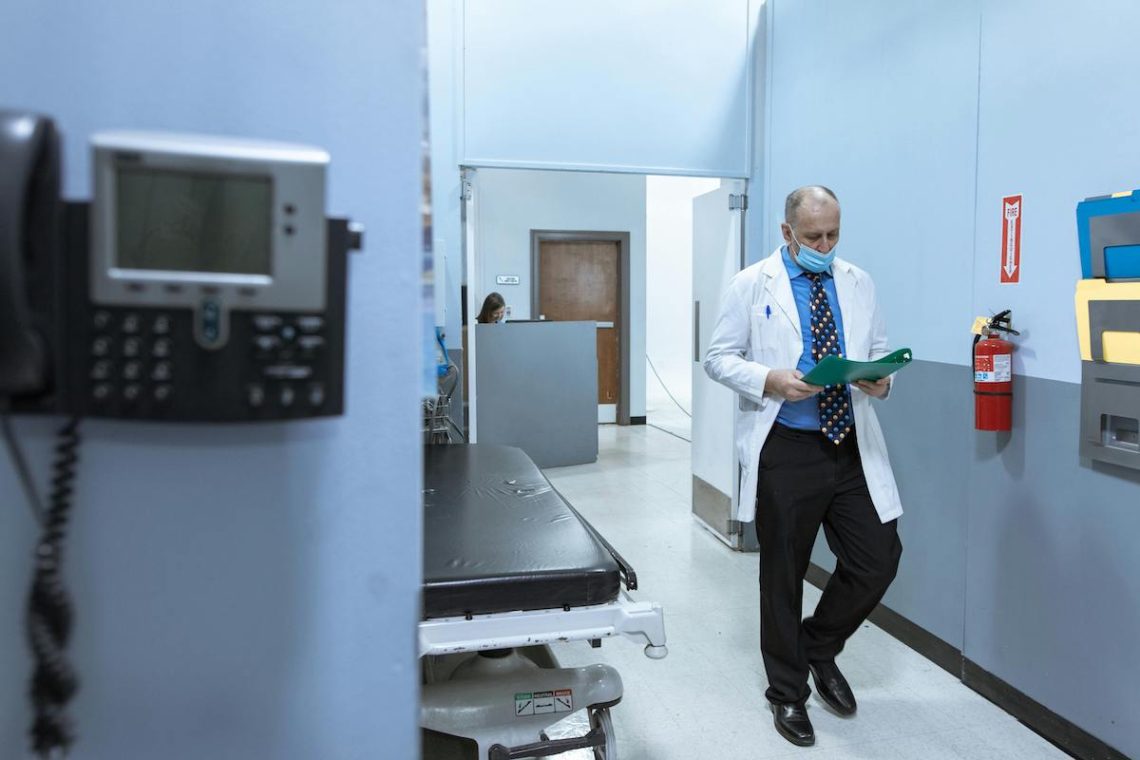
Ukiah emergency room physician Marvin Trotter says that within the next five to seven years, the shortages will grow into a “full-blown health care crisis.” It’s a crisis about which the 58-year-old doctor speaks with eloquence and force.
“You’re going to see more complications and a lesser quality of life,” said Trotter, who puts in 12-hour days three days a week in the emergency room at Ukiah Valley Medical Center, the town’s only hospital. “You’re going to have your foot cut off more as a diabetic. You’re going to have more heart attacks because nobody’s taking care of your cholesterol. You’re going to have more people lose their vision because they can’t get in to see an ophthalmologist. That’s all a function of physician accessibility, and accessibility’s going away.”
Trotter’s quote is a reminder that, for rural America, “doctor shortage” means far more than just primary care. For a broad overview of the growing rural physician shortage, I recommend the “Older doctors, fewer hours” subheading on the story’s first page. The following subhead, “Scarcity at critical levels,” offers a deeper look.
In the second story in the package, Freed looks at how rural communities are working to solve the shortage, and why their efforts keep falling flat.
Related
Program Draws Medical Students to Fresno: A program for third-year medical students is hoping to fight something long intractable: a shortage of doctors in rural and impoverished areas.
New website features center’s health reporting
Calif. organization names AHCJ members to staff
Calif. foundation backs new model; will be hiring
Nonprofit, paper team up for project on med school
Project launches test of a new model for health journalism
How will aging doctors affect your community?
Filed under: Health journalism, Hot Health Headline
AHCJ member Ryan Sabalow, a reporter at the Redding (Calif.) Record Searchlight, recently looked at the age of doctors in his county, finding that “nearly two thirds of Shasta County’s doctors are older than 50, and there aren’t nearly enough young doctors lining up to replace their retiring peers.”
Sabalow freely admits he’s not the first to cover the topic and acknowledges the work of Ventura County Star reporters over the summer. In a Reporting on Health blog post, Sabalow suggests that reporters contact the state medical board and request the an age range of physicians in their county.
The Association of American Medical Colleges forecast that the “passage of health care reform will increase the need for doctors and exacerbate a physician shortage driven by the rapid expansion of the number of Americans over age 65.” For a look at how many physicians are practicing in each state, as well as how many are in school, see the organization’s state-by-state statistics.
Some resources on workforce issues for AHCJ members:
- AHCJ article: How will retiring boomers affect the national health agenda?
- AHCJ article: Caring for aging population will require health care transformation
- Tip sheet: Addressing current and future health workforce hurdles
- Tip sheet: Assessing health reform: Is there a looming doctor shortage?
- Report: VA facilities face shortage of nurse anesthetists
- Report: Preparing for aging boomers
- Report: AAMC’s 2009 workforce report
- Award entry: ‘State struggles with primary care workforce incentives,’ KHI News Service
- Presentation: The Health Workforce Dream Team: Who Will Provide the Care?
Assessing acute care in America
Filed under: Health care reform, Health data, Hospitals, Hot Health Headline
The New York Times‘ Kevin Sack reports on a Health Affairs study that explores “acute medical care,” particularly initial visits for the fever and cough type of stuff that would traditionally go to a primary care physician. While 42 percent of such visits were still handled by a patient’s personal physician, a full 28 percent took place in emergency rooms. According to Sack, that number includes almost all visits made outside of typical office hours, as well as most visits made by patients without insurance.
More than half of acute care visits made by patients without health insurance were to emergency rooms, which are required by federal law to screen any patient who arrives there and treat those deemed in serious jeopardy. Not only does that pose a heavy workload and financial burden on hospitals, but it means that basic care is being provided in a needlessly expensive setting, often after long waits and with little access to follow-up treatment.
Reform provisions such as medical homes, accountable care organizations and more money for primary care seek to rebalance acute care delivery in the United States, but Sack reports that the study’s authors fear it won’t be enough.
The authors warn that it might not be enough. “If history is any guide, things might not go as planned,” they wrote. “If primary care lags behind rising demand, patients will seek care elsewhere.”
Remember, free access to Health Affairs is one of many perks enjoyed by AHCJ members.
Why young docs shun practicing in rural America
Filed under: Health journalism, Hot Health Headline
For a look at the quotidian struggles facing young doctors who accepted federal loan aid in exchange for a three-to-five-year commitment to practicing in underserved rural areas, The Washington Post’s Darryl Fears profiles a 33-year-old, Northwestern-trained doctor working as the only full-time physician at a practice in rural Virginia.
Having learned her trade in a world of electronic medical records and iPhone diagnostic apps, the physician is at sea in a world of paper records, dial-up Internet and 40-mile drives to the full-size grocery store. There are few dating prospects, and even less culture. She’s not convinced that she’ll stay in town beyond her initial commitment.
Retaining these young, eager physicians is the next big challenge facing the stimulus-boosted National Health Service Corps, which placed thousands of doctors in rural areas last year, and is gearing up to do the same this year.
Related
Rural Health Journalism Workshop: Speaker presentations
California’s doctors: Aging, white and specialized
Filed under: Health data, Hot Health Headline, Studies
In California Watch’s blog, Joanna Lin breaks down the California HealthCare Foundation’s latest report on the state’s physician supply. Nationwide, a quarter of physicians are over sixty. In California, which leads the nation in doctors nearing retirement, that number is 29 percent. In addition to aging, the state is also faced with particular ethnic disparities among caregivers.
… Latinos represent 37 percent of the state’s population, but 5 percent of its doctors. The disparity is even greater in the Central Coast, Inland Empire and San Joaquin Valley regions, and most severe in Los Angeles County, where 47 percent of the population and only 5 percent of doctors are Latino. Statewide, 18 percent of doctors speak Spanish.
While California led the nation in retention of graduating state medical students, a “substantial proportion” of California doctors come from other states and countries, Lin writes. That number may shrink as the UC system plans to add two more medical schools in the next five years, budget willing. For more specifics, take a look at the report itself. It’s loaded with easy-to-understand summary statistics and beautiful charts and graphs.
Mass. data show how reform could affect access
Filed under: Government, Health data, Health policy, Hot Health Headline
How will the masses of newly insured post-reform patients impact already tight access to primary care? The Boston Globe’s Liz Kowalczyk has found some hints in the latest results from a Massachusetts patient satisfaction survey. The survey involved about 80,000 commercially insured patients and the data is from 2009.
According to new data from the Massachusetts Health Quality Partners, a coalition that includes doctors, hospitals, and health plans, 83 percent of adult patients said when they called their doctor’s office for care they needed right away, they always or almost always got an appointment quickly.
Fewer patients — 78 percent — reported that they always or almost always got an appointment for a routine check-up or after-hours help as soon as they needed it.
To add some context, Kowalczyk compared the results to numbers from the 2007 survey, which was conducted before Massachusetts had fully boarded the expanded coverage train.
Still, said Barbra Rabson, the group’s executive director, the survey showed slight declines in patient access to their doctors, which could be a warning sign of growing strain in the system. “We need to watch this very carefully,” she said.
In addition to the sort of health care access numbers that bear directly upon reform coverage, the survey also included typical consumer satisfaction-oriented questions. By those measures, at least, care in Massachusetts seems to be improving slightly. The one area of decline? Coordination of care.
24,000 Memphis patients rated their doctors
The Healthy Memphis Common Table is an effort to help patients and providers take charge of improving the city’s health. It includes the results of about 24,000 patient ratings of 430 local primary care doctors, all conducted by the nonprofit Consumers’ Checkbook.
Manoj Jain, M.D., M.P.H., (bio) is on the table’s advisory committee and he, as part of its mission to publicize the effort, wrote a three-part series in the The (Memphis) Commercial Appeal on the results and potential of the survey. The first installment is the one with the broadest appeal, as it discusses survey results and consequences.
In the second installment, Jain profiles a highly rated doctor and includes his own musings on what makes a physician great. Jain then wraps up the series with anonymous profiles of two poorly rated doctors and further musings on how their ratings might be improved. Interestingly, Jain’s suggestions almost always focus on non-clinical factors such as office staff quality and communication skills.
Nurses push to make up for physician shortages
Kaiser Health News’ Andrew Villegas reports that the nation’s 125,000-plus nurse practitioners (and physician assistants, certified nurse midwives and dental therapists) are stepping up to fill the void created by America’s shortage of primary care physicians.
The Association of American Medical Colleges projects that the shortage of primary care physicians will reach 46,000 by 2025 and it will only increase if health care reform efforts succeed and millions of Americans are added to the ranks of the insured, Villegas writes. Nurse practitioners typically handle basic services such as physical exams, common health issues and some drug prescriptions.
Debate over national health overhaul legislation has heightened the sense of urgency about primary care and given nurses ammunition for their argument. “The biggest group of clinicians that will be in shortage with universal (insurance) coverage will be those who provide primary care — and that’s what nurse practitioners are so extraordinarily good at,” says Mary Mundinger, dean of the Columbia University School of Nursing.
There is precedent: Massachusetts’ 2008 health insurance overhaul recognized the 5,600 nurse practitioners as primary care providers who would be reimbursed through private insurance and Medicaid at the same rates as doctors. The nurses, however, must work under written protocols that designate a physician who can provide medical direction.
Despite questions from the American Medical Association, proponents argue that practitioners, who are typically required to have a master’s degree in nursing and work under a doctor’s supervision, know their limits and have proven their competence and effectiveness over several decades.