AHCJ opposes taking taxpayer-funded research out of public’s reach

Congress should not roll back public access to taxpayer-funded research reports, AHCJ wrote in a letter to members of Congress (PDF).research-works-act-011212-1

AHCJ is opposing the Research Works Act (H.R. 3699), which would remove the public’s access to medical journal articles about publicly funded research. They are currently available for free to the public no more than 12 months after their publication in a medical journal.

“Our board of directors believes strongly that more transparency, not less, is vital for the public to assess how funds are spent and to benefit from and learn about the research underwritten by the government,” board president Charles Ornstein wrote in a letter to the House Committee on Oversight and Government Reform. “The recently introduced Research Works Act is a step in the wrong direction.”

In the letter, AHCJ rebutted medical publishers’ assertions that the current system doesn’t work.

“We understand the objections of such publishers, who contribute editorial support and fear loss of income,” Ornstein wrote. “But it’s worth noting that much of that support comes from unpaid peer reviewers. And publishers still maintain a year of exclusivity, enabling them to reap profits during the time when interest in research is highest.”

In 2010, AHCJ voiced concerns about a similar bill, which did not become law.

AHCJ objects to CMS meeting privately with investors

Responding to a report that federal health officials met in private with Wall Street investors, AHCJ leadership sent a letter to the acting administrator of the Centers for Medicare and Medicaid Services objecting to the selective release of information to stakeholder groups.

cms-letter-12-2011-thumbThe Project on Government Oversight reported earlier this month that a dozen senior staff at CMS met with five Wall Street professionals for nearly two hours in 2009 and that a senior CMS analyst filed an ethics complaint about it.

AHCJ’s letter, signed by president Charles Ornstein, states, “We feel strongly that journalists should receive information from CMS no later than other groups. If guidance or previews are provided to special interest groups, it also should be provided to journalists, who inform the public.”

The letter to acting CMS administrator Marilyn Tavenner was sent on Dec. 15.

AHCJ does not seek to prevent CMS from meeting with members of the public including stakeholders. Nor is the group asking for journalists to receive confidential information from the agency about pending decisions.

“But we don’t think the public should be the last to know about CMS actions. Journalists should be in the loop when information is released,” the letter said.

Public becoming more active in pursuit of goverment information, media less active

Aug. 24th, 2011 by Pia Christensen · Leave a Comment
Filed under: Public records 

The public’s interest in government transparency is growing and citizens are “becoming more active in asserting their right to government information,” according to a new survey from the Media Law Resource Center and the National Freedom of Information Coalition.

The survey also found, perhaps less surprisingly, that news organizations are less likely to sue for access to public information because of a lack of resources.

The new findings include both good news and bad, said Kenneth F. Bunting, executive director of the National Freedom of Information Coalition.

“If ordinary citizens are becoming more aware of their access rights, and more assertive regarding them, it is indeed a reason to be gratified,” he said. “However, if news organizations are trending toward being less gung-ho in an area once regarded as a matter of responsibility and stewardship, there is the frightening potential that journalism could suffer, as could the health of our democracy.”

Among the findings:

  • Media lawyers and representatives of the NFOIC member coalitions said they had seen an increased number of open government violations in recent years.
  • The number of open records requests made by private citizens and other non-media organizations has increased.
  • 60 percent of media lawyers surveyed noted a decrease in open government lawsuits by media organizations over the past five years.

The survey also looked at the prevalence and effectiveness of FOI hotlines, finding that they “got generally high marks from all respondents.”

Read more:

(Hat tip to Joey Senat, Ph.D.)

LA Times op-ed explains need for guidelines on information in a public health emergency

In an op-ed in today’s Los Angeles Times, Felice J. Freyer and Charles Ornstein, members of AHCJ’s board of directors, write that releasing accurate information in a public health emergency reassures the public that officials are being honest about what they know and what the risks are.

The piece includes several examples of public health emergencies in which officials have been less than forthcoming.

As board members of the Assn. of Health Care Journalists, we have been troubled by the way some health officials cite privacy laws as the reason for withholding information that, by law, doesn’t have to be private.

The op-ed piece also introduces the set of guidelines that AHCJ established with the Association of State and Territorial Health Officials and the National Association of County and City Health Officials about what information should be made public.

Previously: Health officials, journalists agree on standards

Health officials, journalists agree on standards for releasing information

New guidance addresses public health emergencies

Public health officials and journalists now have guidance on what information should be made public when someone dies or falls ill during a public health emergency, thanks to a unique collaborative effort being made public today.

A new document – developed by leaders in public health and health-care journalism – provides a framework for releasing such information as the age and location of private individuals who have been affected by an epidemic or other public-health event.

These nonbinding recommendations, “Guidance on the release of information concerning deaths, epidemics or emerging diseases,” are meant to help public health officials balance the need to keep the public informed with requirements to maintain individuals’ privacy.

The guidance emphasizes the importance of openness, stating that information should be withheld only when there is a clearly justified reason.

The Association of State and Territorial Health Officials (ASTHO), the National Association of County and City Health Officials (NACCHO), and the Association of Health Care Journalists (AHCJ) teamed up to develop the guidance after the H1N1 “swine flu” pandemic of 2009.

Read the complete press release.

Earlier

Presidents of AHCJ, SPJ call for more openness from Obama administration

Apr. 1st, 2011 by Pia Christensen · Leave a Comment
Filed under: Health journalism, Public records 

The presidents of the Association of Health Care Journalists and the Society of Professional Journalists published an op-ed in The Washington Post this morning, criticizing the lack of openness within the Obama administration and calling on officials to improve the flow of information to journalists and the public.

Charles Ornstein

Charles Ornstein

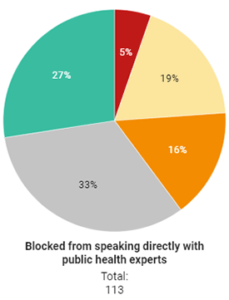
“Democrats criticized the Bush administration for not making decisions based on the best science,” wrote AHCJ’s Charles Ornstein and SPJ’s Hagit Limor. “But the Obama administration now muzzles scientists and experts within federal agencies. When they are allowed to talk about important public health issues, a chaperone often supervises every word. These constraints keep the public from learning whether decisions are science-based or politically motivated.”

AHCJ has been very active in advocating for government openness, including a recent series of meetings in Washington, D.C., with officials from the U.S. Department of Health and Human Services and its related agencies. The organization has urged the FDA to re-examine a policy that prohibits reporters from sharing embargoed materials with sources before the embargo lifts for the purpose of obtaining outside comment and context. Board members from AHCJ also have worked with state health directors to encourage dissemination of more information during public health outbreaks.

“We remain hopeful that our ongoing conversations with HHS and its agencies will help improve the current climate, which isn’t working for journalists or the public,” Ornstein said. “Our members are interested in timely, meaningful responses to their questions, additional access to scientists and health experts, and speedier responses to their Freedom of Information Act requests.”

Senators join fight to open Medicare claims data

Two senators have joined the effort to open up the Medicare claims database that reveals what payments doctors get through the system.

Covering Health readers might remember that Dow Jones & Co. – parent company of The Wall Street Journalfiled a lawsuit in January in its attempt to overturn an injunction that “prevents the public from knowing how much taxpayer money individual doctors receive from the Medicare program,” according to a press release.

Republican Sen. Chuck Grassley of Iowa and Democrat Sen. Ron Wyden from Oregon are pushing legislation to overturn the same 1979 injunction.

Neither senator, nor Dow Jones, seek the release of private patient data. The Medicare claims data has proven useful in fighting fraud and abuse in the system, allowing journalists or investigators to identify anomalies.

Grassley said “he was prompted in part” by articles in The Wall Street Journal about the Medicare database and fraud. Wyden, who spoke at Health Journalism 2009, said he plans to discuss joining forces with Grassley, saying, “I believe we can have a bipartisan bill on this.”

Preventing health care fraud was the subject of a Senate finance committee hearing on Wednesday, where Grassley and Wyden heard from the director of the Center for Program Integrity, Centers for Medicare & Medicaid Services, and from Daniel Levinson, inspector general for the U.S. Department of Health and Human Services. Their statements, as well as video of the hearing, are available online.

Reporters urged to insist on response from federal agencies

When the FDA would offer only “no comment” on a notorious incident last summer, Felice J. Freyer, a medical writer at The Providence (R.I.) Journal, was disappointed but not surprised. She published her story about an FDA matter (the use of unapproved IUDs) without the FDA’s input.

But Freyer became concerned when, four days after her story came out, the FDA posted on its website a “consumer update” that answered some, but not all, of the questions she had posed to the agency.

“Turns out the FDA’s position was not the ‘no comment’ I received,” Freyer wrote in an account of the incident posted on the AHCJ website.

FDA headquarters in White Oak, Md.
(Photo by thisisbossi via Flickr)

“I don’t think the FDA had anything major to hide,” Freyer added. “It seemed like the agency just couldn’t be bothered with my questions, preferring to focus on a statement for release on its own time.”

But the web-only consumer advisory left questions unanswered and probably reached few consumers.

Freyer, who is an AHCJ board member and chair of AHCJ’s Right to Know Committee, complained about the incident, pursuing the matter up the chain of command. She eventually received an apology, but little by way of explanation. She is sharing her experience in the hope of encouraging other reporters - especially the beleaguered folks who work for the regional media - to persist in seeking information from the federal government.

“The Obama Administration has done some admirable work posting user-friendly information on the Internet,” Freyer said. “But as long as the administration’s press officers ignore and deflect reporters’ questions, the government’s websites begin to function like a state-sponsored press, containing only the information the government wants to share, forever impervious to questioning.

“I urge my fellow journalists to push back against this trend.”

FOI request for H1N1 documents still pending

Eleven months after she filed a Freedom of Information Act request with the Centers for Disease Control and Prevention for documents related to H1N1, CBS News’ Sharyl Attkisson reports that she has finally received a response from the U.S. Department of Health and Human Services.

It states that it has a certain document responsive to my FOI request. The letter says HHS will try really hard to provide the document soon, but that the folks there are very busy so it may take awhile. It says that if I want expedited processing - something I had already applied for a year ago - I should let them know. A phone number was provided in case I had any questions.

Of course the investigative report I was working on is long over, as the bureaucrats must have known it would be by now.

Attkisson says she called the number provided in the letter and left a message several weeks ago and has yet to hear back. Her initial request was prompted by the CDC’s decision to stop testing and tracking H1N1, something her sources told her was hasty and more about influencing the public’s perception of the illness than it was about public health.

Earlier: Freedom of Information: Stalled at CDC and D.C. Government (Oct. 27, 2009)

Related

Officials struggle with timing of outbreak alerts

The Redding (Calif.) Record Searchlight’s Ryan Sabalow put together a local take on ongoing inconsistencies in how local health departments release outbreak-related information to the public.

Sabalow brings the story home  with examples from local health departments and the story of  a child who died from bacterial meningitis in an area where a previous case had gone unannounced. In the first story, Sabalow explains the nuances of when and how certain health departments choose to disclose infections, and in the second he shows just how messy and inconsistent those standards can be in practice.

At issue is the struggle to find a balance between transparency and panic-causing cries of “wolf.” It’s an issue AHCJ has tackled before, most notably during the 2009 H1N1 outbreak when disclosure varied wildly from department to department.

Felice J. Freyer, a health reporter at the Providence Journal in Rhode Island who heads the Association of Health Care Journalists’ Right to Know Committee, said a perception of secrecy is the last thing health officials need when they’re urging people to take steps to protect themselves from a disease.

“You can’t sustain the public’s trust if you run and hide,” Freyer said. “That’s what it looks like, whether that’s what’s happening or not.”

Freyer said AHCJ members have been in talks with the Association of State and Territorial Health Officials. The nonprofit health organization has agreed to meet with the AHCJ to determine whether a nonbinding set of national guidelines can be developed.

Somewhere at the other end of the spectrum is Dr. Rob Hamilton, head of a Redding hospital’s emergency department.

Hamilton said he empathizes with public health officials in holding back until a case is confirmed.

One false alarm about a suspected meningitis case could potentially flood an already crowded emergency medical system with dozens of scared patients who don’t have meningitis but are demanding expensive, potentially dangerous and time-consuming spinal taps, he said.

Related

Kim Archer of the Tulsa World has been covering an outbreak of meningitis that has killed two children and made at least five others sick. She talked to school and health officials about the public health response to the outbreak and compiled a timeline of the outbreak and response.

Next Page »