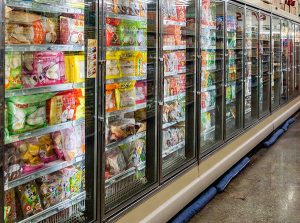
Project follows the race to make bagged salad safer
The latest investigation by California HealthCare Foundation Center for Health Reporting’s Deborah Schoch will make you think twice before ripping into a sack of spring mix, but her work about the myriad food safety challenges posed by bagged salads examines the industry’s struggle to develop technology powerful enough to overcome the existential threat posed by E. coli and friends.
The industry has made great strides since a 2006 outbreak linked to tainted spinach, she writes, but “It’s impossible to stop all pathogens from landing on lettuce and spinach leaves.” And once they’re on the leaves, it seems as if their spread is almost inevitable. They hide in gooey biofilms and resist powerful washes.
Thousands upon thousands of salad leaves are taken to a central plant, washed together, bagged and shipped. Even if only a few leaves are tainted, harmful pathogens can spread in the wash water — the modern salad version of the old adage that one bad apple spoils the whole barrel.
“I would think of it as swimming in a swimming pool in Las Vegas with a thousand people I didn’t know,” said William Marler, a prominent Seattle-based food safety attorney.
Plenty of public and industry money has been aimed at the problem, Schoch writes. “The Center for Produce Safety at UC Davis, founded in response to the spinach outbreak as an industry-public partnership, has pumped more than $9 million into 54 research projects at 18 universities.”
Even the best research can’t reduce the risk of contaminated greens by 100%, scientists said. At Earthbound, Daniels says the ultimate goal is to achieve what scientists call a “5 log reduction,” the equivalent of pasteurizing milk. In short, if an unwashed lettuce contained 100,000 pathogens, the perfect wash system would knock off five “0s” and reduce the pathogen count to 1.
An added bonus? Schoch’s column on whether she (and the experts she talked to) feel like it’s important, or even salutary, to wash their bagged greens.
New stats: 1 in 6 get foodborne illnesses each year
More precise estimates than previously available find that one in six Americans suffer foodborne illnesses annually and that 3,000 die of such diseases.
The CDC says the newly released reports are the most accurate to date. They are “the first comprehensive estimates since 1999 and are CDC’s first to estimate illnesses caused solely by foods eaten in the United States.” According to the CDC’s release, these estimates are lower than those in the 1999 report, largely because of “improvements in the quality and quantity of the data used and new methods used to estimate foodborne-disease. ”
The articles are in the January 2011 issue of Emerging Infectious Diseases:
• Foodborne Illness Acquired in the United States—Major Pathogens (PDF)
• Foodborne Illness Acquired in the United States—Unspecified Agents (PDF)
Other findings:
- Salmonella was the leading cause of estimated hospitalizations and deaths
- About 90 percent of estimated illnesses, hospitalizations, and deaths were due to seven pathogens: Salmonella, norovirus, Campylobacter, Toxoplasma, E.coli O157, Listeria and Clostridium perfringens.
- Nearly 60 percent of estimated illnesses, but a much smaller proportion of severe illness, was caused by norovirus.
The reports were the subject of a telebriefing this morning; the transcript should be available later.
Additional resources
- Fatal Food: A study of illness outbreaks
- Lifting the shroud: Using multiple-cause-of-death data
- FDA Reform: The Time Has Come (Nancy Donley presentation)
- Why Is It So Difficult to Prevent Foodborne Illnesses? (Michael Doyle presentation)
- Reporting on the intersection of health and the environment
- Center for Infectious Disease Research & Policy
- Outbreak Alert! Database
Investigating, localizing salmonella outbreak
Filed under: Health data, Health journalism, Hot Health Headline
As some of you may have noticed, there’s an egg recall going on. It all began when the CDC’s PulseNet monitoring program noticed a fourfold jump in the number of salmonella cases being reported, which spurred investigations around the country. This jump is evident in the graph below. Don’t be fooled by the dropoff at the end, it has more to do with the reporting process than with an actual decrease in the number of salmonella cases (which clearly isn’t happening).
Health officials then traced it all back to a man outlets love to describe as a sort of rogue Iowa egg magnate and his Wright Country Eggs (satellite view?).
As we stand now, the tainted eggs could have been distributed through any number of channels, but constitute a tiny fraction of the national egg supply.
For reporters digging into this national recall story, or looking to localize it to their coverage area, AHCJ has a strong archive of foodborne illness resources.
Start with a classic, the AHCJ article “Fatal Food: A study of illness outbreaks ,” in which Thomas Hargrove details SHNS’ massive investigation into the nation’s food safety monitoring system. Not only is Hargrove’s how-to instructive, his actual findings are useful examinations of state and local food safety systems around the country.
For your own investigation, look at Mining NLM databases: PubMed, Medline and more and the rich set of resources in the sidebar to Hargrove’s story.
If you’re looking for solid numbers and the most up-to-date national context, see Covering Health’s recent post on the CDC’s lates foodborne illness data, as well as our examination of 2009 foodborne illness rates.
Other relevant Covering Health posts include:
Schneider: FDA lacks resources to keep food safe
CDC assembles rogues gallery of food bugs
Private food auditors didn’t stop outbreaks
Lax oversight, complex supply chains aid outbreaks
CDC releases 2007 foodborne illness numbers
In the latest Morbidity and Mortality Weekly Report, the CDC has released the 2007 numbers on foodborne illness in the United States. Norovirus (39 percent) was the most common culprit, followed by Salmonella (27 percent). In terms of illnesses caused, poultry led the way, followed by beef and leafy greens. In the majority of the 1,097 reported outbreaks of foodborne illness, no agent was identified – a fact the CDC attributes to the small scale of many of those outbreaks. Here’s a breakdown of what investigators managed to find:

Those looking to dig a little bit deeper into the numbers should consult this four-page PDF, which breaks it all down by contaminant, food, number of outbreaks and number of illnesses caused.
Resources for covering food safety
Tip Sheets
- Lifting the shroud: Using multiple-cause-of-death data
- FDA Reform: The Time Has Come (Nancy Donley presentation)
- Why Is It So Difficult to Prevent Foodborne Illnesses? (Michael Doyle presentation)
- Reporting on the intersection of health and the environment
- Fatal Food: A study of illness outbreaks
Websites
- Center for Infectious Disease Research & Policy
- Outbreak Alert! Database
- Center for Food Safety and Security Systems
- FoodRisk.org
Related
- Recent stories and studies on foodborne illnesses
- Video study finds risky food-safety behavior more common than thought
- Airlines delay testing of onboard water
- A selection of stories about a 2008 salmonella outbreak
- Private companies, not the FDA, increasingly perform food safety inspections
Little recent progress on foodborne illnesses
The CDC’s Morbidity and Mortality Weekly Report contains some early numbers on foodborne illness rates in 2009. The data, NPR health blogger Scott Hensley writes, aren’t promising, and it looks like most infection rates haven’t really improved since 2004. A transcript and audio of the April 15 media briefing is available.
The report comes with data for the 10 states monitored by the CDC’s Foodborne Diseases Active Surveillance Network; they’re also broken down by age. To demonstrate just how variable the infection rate is, we’ve pulled numbers for two of the most common foodborne illnesses, salmonella and campylobacter.

AHCJ resources
Tip Sheets
- Lifting the shroud: Using multiple-cause-of-death data (03/17/07)
- Melamine: A primer on the contamination of food (09/25/08)
Article
- Fatal Food: A study of illness outbreaks (02/19/07)
Web sites
AHCJ Award winners
- A Body’s Burden: Our Chemical Legacy (03/01/06)
- Border Health Series (03/01/06)
Health News
- Loophole allows E. coli-tainted meat to be sold (11/15/07)
- Meat, dairy products transported in unsafe temperatures, overlooked by inspectors (11/15/07)
- Airlines delay testing of onboard water (02/20/08)
- Salmonella outbreak: A selection of recent stories (06/24/08)
- N.Y. school districts not meeting federal guidelines on cafeteria inspections (09/26/08)
- Private companies, not the FDA, increasingly perform food safety inspections (09/26/08)
Private food auditors didn’t stop outbreaks
Michael Moss and Andrew Martin of The New York Times reviewed several major recent outbreaks of foodborne illness and discovered that auditors, private contractors who are often paid by the companies they inspect, “failed to detect problems at plants whose contaminated products later sickened consumers.”
“The contributions of third-party audits to food safety is the same as the contribution of mail-order diploma mills to education,” said Mansour Samadpour, a Seattle consultant who has worked with companies nationwide to improve food safety.
Audits are not required by the government, but food companies are increasingly requiring suppliers to undergo them as a way to ensure safety and minimize liability. The rigor of audits varies widely and many companies choose the cheapest ones, which cost as little as $1,000, in contrast to the $8,000 the Food and Drug Administration spends to inspect a plant.
Even when private auditors detect violations, Moss and Martin reported, the companies are under no obligation to correct them.
Robert A. LaBudde, a food safety expert who has consulted with food companies for 30 years, said, “The only thing that matters is productivity.” He added that “you only get in trouble if someone in the media traces it back to you, and that’s rare, like a meteor strike.”
Some companies have refused to use the nation’s 200 auditing corporations or numerous independent contractors, instead preferring strict internal controls.
Related
- Following the salmonella outbreak at a Georgia peanut processor, The Atlanta Journal-Constitution examined the state’s peanut inspection system and found troubling gaps: Inspectors often fail to follow up on violations, and few have backgrounds in science. Georgia’s chief inspector responded, “We’re satisfied with the inspections that were done, because they are a snapshot in time.”
- Salmonella outbreak may linger for 2 years
- Lax oversight, complex supply chains aid outbreaks
- Fatal Food: A study of illness outbreaks: Thomas Hargrove of Scripps Howard News Service wrote about food-borne illness outbreaks in a 2007 article for AHCJ. He found that some states did a good job of diagnosing and tracking down the causes of outbreaks, while other states “are virtually blind in detecting outbreaks of food illness.”
- HHS’s new social media team focuses on outbreak
Salmonella outbreak may linger for 2 years
The Atlanta Journal-Constitution’s Craig Schneider reports that, because of the long shelf-life of peanut products and the difficulty and complexity of recalling all products made with tainted peanut butter, Peanut Corp. of America’s salmonella outbreak could be sickening consumers for two more years.
The process of identifying those products and ensuring their removal has been complicated and confusing, said Dr. Stephen Sundlof, director of food safety at the U.S. Food and Drug Administration.
“We’re really concerned. This is not over yet,” Sundlof said. He said the outbreak could last as long as products are around, possibly as long as two years.
That’s because peanut products, seemingly harmless as they linger in homes and the marketplace, can have a relatively long shelf life, officials said. Vegetables and meat, which spoil relatively quickly, must be thrown away.
Lax oversight, complex supply chains aid outbreaks
In the wake of recent food-borne salmonella outbreaks, Justina Wang of the Rochester Democrat and Chronicle found that a combination of a complex supply chain and lax federal oversight has allowed a steady stream of dangerous pathogens to slip into the food supply.
Given the complexity of today’s food processing and distribution networks, Wang found that many health experts don’t see an end to the outbreaks.
“Absolutely it will continue to happen until big changes are made,” said Sanford Miller, former director of the FDA’s Center for Food Safety and Applied Nutrition and a senior fellow at the University of Maryland. “The food industry has just exploded over the last several decades, and unfortunately, the FDA has not been able to keep up with this.”
Pathogens can lurk in food for months and by the time someone becomes ill and is tested and diagnosed with a potentially dangerous food-borne illness, officials said, the outbreak may already be in full swing. Once the outbreak is detected, even more time passes as product recalls are put into place.
Related:
- Fatal Food: A study of illness outbreaks: Thomas Hargrove of Scripps Howard News Service wrote about food-borne illness outbreaks in a 2007 article for AHCJ. He found that some states did a good job of diagnosing and tracking down the causes of outbreaks, while other states “are virtually blind in detecting outbreaks of food illness.”
- HHS’s new social media team focuses on outbreak
Doctor suggests reforms to stop foodborne illness
Writing in the New England Journal of Medicine, Dennis G. Maki, M.D. takes a look at foodborne illness, the sources of recent outbreaks and official attempts to control the food-based spread of pathogens.
Once again, we must ask ourselves how foodborne disease can develop in 76 million residents of one of the world’s most technically advanced countries each year, causing 350,000 hospitalizations and 5000 deaths and adding $7 billion to our health care costs, despite intensive regulation of food production and distribution.
Industrial food production and importation, the American fondness for eating at restaurants and centralized distribution have helped to multiply the damage caused by any single outbreak, Maki said.
Maki suggested several possible measures to combat the spread of foodborne pathogens:
- Requiring bar codes for all commercial food so its origins and contact points can be quickly and easily traced.
- Changing the feeding practices of cattle, poultry and swine and reduce reliance on practices like anti-microbial food supplements that may promote the growth of harmful bacteria.
- Improving hygienic food-preparation practices in homes, restaurants and hospitals and giving local health departments the power and means to monitor these practices.
- Irradiating high-risk foods because “the CDC has estimated that irradiation of high-risk foods could prevent up to a million cases of bacterial foodborne disease each year in North America.”
Related:
Fatal Food: A study of illness outbreaks
Thomas Hargrove of Scripps Howard News Service wrote about foodborne illness outbreaks in a 2007 article for AHCJ. He found that some states did a good job of diagnosing and tracking down the causes of outbreaks, while other states “are virtually blind in detecting outbreaks of food illness.”
HHS’s new social media team focuses on outbreak
File this one under “No sooner said than done.” Just last week, Pete Blackshaw wrote on the ConsumerGeneratedMedia.com blog that the FDA could and should use social networking and digital media to better reach and educate consumers about the recent Salmonella outbreak. He suggested:
- Using video to connect with and reassure consumers;
- Including links that make it easy to share content through e-mail and social networking sites;
- Creating a presence on social networking sites like Facebook and MySpace;
- Creating widgets that can be used on other Web sites to help share FDA info;
- Building a blog that provides a steady stream of info about the recalls;
- And using photos of product involved in the recall.
Lo and behold, the FDA issued this release announcing a new social media Web page featuring several of the same ideas, as well as podcasts in English and Spanish, a Twitter option and health e-cards for Salmonella updates (a gesture that, supposedly, is designed to show someone that you really care). In what may be a signal of real change, the effort is being directed by the Department of Health and Human Services’ new Center for Social Media Center, “a collaborative body dedicated to advancing social media adoption, research and evaluation among Federal agencies.”
One thing lacking, however, is a sense of urgency: the latest news is not displayed, which forces readers to conduct a search for the most recent developments. But take a look and decide for yourself. Overall, is this a step in the right direction? And how might it be improved?
Note: The CDC and FDA are holding a special webinar today for bloggers about the Salmonella Typhimurium outbreak and associated recalls of peanut butter and peanut-containing products.