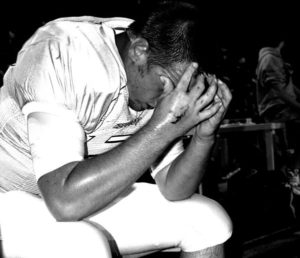
Concussion-related trauma masquerades as ALS
The New York Times‘ Alan Schwarz reports on what he says is “the first firm pathological indications that brain trauma results in motor-neuron degeneration.” The headline behind that conclusion, of course, is that researchers say some athletes with concussion and impact-induced brain injuries may have been misdiagnosed as ALS victims.
Photo by peterjr1961 via Flickr
In interviews, the study’s authors even speculate that Lou Gherig, who gave the disease its popular name, may have instead suffered from a similar disease caused in part by brain injuries.
The finding was not unexpected, given that ALS seemed to occur at much higher rates in concussion-heavy populations like athletes and soldiers.
Schwarz’s summary of the study:
Doctors at the Veterans Affairs Medical Center in Bedford, Mass., and the Boston University School of Medicine, the primary researchers of brain damage among deceased National Football League players, said that markings in the spinal cords of two players and one boxer who also received a diagnosis of A.L.S. indicate that those men did not have A.L.S. at all. They had a different fatal disease, doctors said, caused by concussionlike trauma, that erodes the central nervous system in similar ways.
It’s in the emergence of that second disease that really seems to have attracted Schwarz’ attention. It behaves similarly to ALS, but shows a distinct protein pattern that only seemed to emerge in patients with a history of head injury. There is not, however, a 1:1 relationship. Other factors seem to also be at play, Schwarz writes.
Gary Schwitzer of HealthNewsReview.org examines the story more closely and concludes that, while this is an “important and fascinating area of research,” the story “did not exhibit the best of health/medical/science journalism.” He lists seven points of criticism and includes comments from one of the site’s medical editors.
John Gever of MedPage Today offers more scientific coverage of the study and points out that there was no mention of Gehrig in the study but that “a New York Times reporter coaxed McKee into suggesting that Gehrig may have been among those misdiagnosed – even though, as a first baseman, he did not routinely experience violent collisions. (He was, however, beaned at least twice during his 14-year career with the New York Yankees.)”
Stadium concessions rack up health violations
ESPN’s Paula Lavigne examined 2009 health department inspections from the 107 stadiums that host MLB, NBA, NHL and NFL games in the United States and Canada. The resulting report may keep you from indulging in your favorite ballpark food.
At 30 of the venues (28 percent), more than half of the concession stands or restaurants had been cited for at least one “critical” or “major” health violation. Such violations pose a risk for foodborne illnesses that can make someone sick, or, in extreme cases, become fatal.
Photo by Katie Spence via Flickr
An interactive map lets you see the venues based on the number of violations there; rolling your mouse over the location tells you the percentage of vendors found in violation and gives some information about the kinds of violations that were found.
The same information, compiled by Lavigne and Producer Lindsay Rovegno, is also available in a text format broken down by state.
Many of the excerpts cite instances in which food was not being kept at appropriate temperatures and a few are related to pests, but there are a few more unusual examples:
- At the Jobing.com Arena, where the Phoenix Coyotes play, “inspectors spotted an employee scooping ice with his bare hands instead of using scoops.”
- At Dodger Stadium, there was mold growing inside an ice machine.
- At Invesco Field at Mile High Stadium and at the Pepsi Center in Denver, inspectors found flies in bottles of liquor.
- At Ford Field, home of the Detroit Lions, inspectors found an employee’s half-eaten hamburger in a warming unit.
Another interesting note: Food inspectors aren’t always visiting unannounced nor are they always visiting when concessions are open. In Chicago, inspections are done when the stadiums are empty and no workers are preparing or serving food. At Cincinnati’s Paul Brown Stadium, inspectors must “submit a list of employees’ names and make an appointment a few days in advance.”
Reporters who have a major sports venue in their community might want to see how it stacks up against others, what kinds of violations have been found and do some further reporting.
Resources for covering food safety
Tip Sheets
- Lifting the shroud: Using multiple-cause-of-death data
- FDA Reform: The Time Has Come (Nancy Donley presentation)
- Why Is It So Difficult to Prevent Foodborne Illnesses? (Michael Doyle presentation)
- Reporting on the intersection of health and the environment
- Fatal Food: A study of illness outbreaks
Websites
- Center for Infectious Disease Research & Policy
- Outbreak Alert! Database
- Center for Food Safety and Security Systems
- FoodRisk.org
Related
- Recent stories and studies on foodborne illnesses
- Video study finds risky food-safety behavior more common than thought
- Airlines delay testing of onboard water
- A selection of stories about a 2008 salmonella outbreak
- Private companies, not the FDA, increasingly perform food safety inspections
Group hopes to track jockey injuries
At present, the horse racing industry maintains a database of horse injuries and deaths, yet does not afford the human athletes that ride them the same courtesy. The (Louisville) Courier-Journal’s Gregory Hall reports that there may finally be some momentum to change that, given talks at the “Welfare and Safety of the Racehorse Summit” – the same event at which such a database was first proposed several years ago.
The original summit in 2006 made a similar recommendation to create a human injury database, which was paired with the recommendation that led to the Equine Injury Database, which now receives reports from 86 racetracks. Those racetracks represent more than four-fifths of thoroughbred flat races and all steeplechase races.
Gathering statistics on the timing, nature and cause of the injuries would be a huge step toward increasing jockey safety.
According to Jockeys’ Guild statistics, 128 riders have died since 1940 from injuries suffered on racetracks in the United States, The Courier-Journal reported in April. Currently, about 60 riders who suffered brain or spinal-cord injuries receive modest aid from the racing industry’s Permanently Disabled Jockeys Fund.
Just this week, two jockeys were injured during racing at a Tulsa, Okla., track – one suffered a broken neck.
More coverage:
In major leagues, mental illness losing its stigma
Calling Major League Baseball a “longtime fortress against psychiatry” Sports Illustrated’s Pablo S. Torre profiles the organization’s recent efforts to go from an organization notorious for its lack of crying to one which takes the mental health of its players very seriously.
Photo by Sister72 via Flickr
… baseball has led the way in supporting a growing number of players who have been brave enough to seek assistance for such problems and speak out about them. “Baseball’s older generations like to say, ‘Guys these days just aren’t as tough,’” says Ray Karesky, a licensed psychologist who has directed the Oakland A’s Employee Assistance Program (EAP) since 1984. “But what’s different is just that guys have come out and actually admitted their problems.”
Baseball, with its high failure rates (a great hitter still fails two out of every three at-bats), spotlight on individual performance, substantial downtime and long nights on the road, is loaded with mental health stressors. But it’s only now, thanks to the “cover” provided by those few major leaguers bold enough to come forward with their problems, that players at all levels are comfortable enough to address mental health. The revolution began last year, when an unprecedented five big leaguers went on the disabled list for mental health problems — so-called “mental DLs.”
This number isn’t anywhere close to those reported for the general population—the National Institute of Mental Health estimates that 26.2% of Americans ages 18 and older suffer from a diagnosable mental disorder in any given year—but for baseball it represents a sea change: Between 1972 and ‘91 the grand total of mental DLs in the major leagues was zero.
Concussion more likely when hit is unexpected
There’s anecdotal evidence that athletes are less likely to get concussions if they were ready for the impact before it arrived, but it’s not an easy premise to test. The primary concerns are ethical ones, of course, as it’s hard to justify enrolling patients in a condition that calls for “sneaking up and, when they’re least expecting it, whacking them in the skull hard enough to deliver a concussion.”
Photo by sphilp1225 via Flickr
Fortunately, researchers for a study published in the June issue of Pediatrics found a clever way to isolate those conditions in a place where they “naturally” occur, namely a youth hockey game.
They started by fitting the young players’ helmets with monitors to measure impact data, then let them play. Researchers then divided the impacts into two categories: Those that occurred along the boards where players expect to be checked, and those that happened mid-ice and were thus more likely to come as a surprise.
Chicago Tribune blogger Julie Deardorff, who alerted us to the study, describes the results:
Of 666 body collisions, 421 took place along the playing boards, and the remaining 245 hits occurred on the open ice. On average, the open-ice collisions were more severe than those occurring along the playing boards, the study authors found.
Deardorff then evaluates youth hockey impacts relative to those in other sports, and ends with the recommendation that youth hockey players “skate through” checks, and keep moving instead of staying put along the boards and absorbing all the kinetic energy of the blow.
Focus on hockey’s head injuries grows
Poynter Institute’s Al Tompkins takes a look at hockey injuries, especially head injuries.
Photo by Alex Kehr via Flickr
He points to an article in the Globe and Mail about the long-term effect of concussions and what Canada is doing to combat the issue, contrasted with what some places in the United States are doing to better treat and prevent concussions.
The article cites a study in the March 2009 issue of Brain that found former athletes were still suffering the effects of their head injuries more than 30 years after their last concussion.
Tompkins also notes the National Hockey League – which had 10 players out with head injuries in November – is confronting the problem by banning “blindside hits” to the head.
Even pro wrestling has a wellness program
Wrestler Chris Jericho fights WWE colleague Eddie Fatu (aka “Umaga”). Fatu died at age 36 after a Dec. 4, 2009 heart attack. He had been kicked from the WWE for wellness program violations in June. Photo courtesy of the Wikimedia Commons.
Writing for Human Resource Executive Online, Jared Shelly explained World Wrestling Entertainment’s version of an employee wellness program. With at least 22 professional wrestlers (including a number of high-profile WWE stars) dying before their 45th birthday since 2003, the health challenges faced by the high-impact WWE aren’t exactly typical, and neither is their wellness program.
For starters, the wrestlers are technically independent contractors, not employees, and the wellness program is run by a third party contracted by WWE. The program itself, instituted in 2006, revolves around drug testing (both for the performance enhancing and recreational varieties) four times a year, with suspensions and testing escalating with every instance in which a particular wrestler tests positive.
Wrestlers’ contracts are terminated after their third violation of the policy, but they are still eligible for the Former Talent Rehabilitation Program, an anti-drug-addiction prorgam used by about 4 percent of former WWE wrestlers.
House holds hearing on brain injuries in NFL
The House of Representatives is holding a hearing on “Legal Issues Relating to Football Head Injuries” that is being webcast on C-SPAN.org.
The witness list includes NFL commissioner Roger S. Goodell as well as the director of the players association, team executives, doctors, neurologists, retired players, families of former players and safety advocates.
Related
The New York Times: NFL Data Reinforces Dementia Links
Ky. county to warn coaches about air pollution
In a story that shows how health stories can span several beats, James Bruggers, writing for the Louisville Courier-Journal’s kentuckianagreen.com, reports that the Jefferson County School District (which includes Louisville) will now share air pollution warnings with district coaches, who may then use that information to alter practice schedules.
The decision comes as a statewide sports safety work group created by the Kentucky General Assembly is scheduled to take up questions about air quality and outdoor practice at a meeting Thursday in Lexington. The Kentucky High School Athletic Association also is weighing possible recommendations on air quality and sports practices to its 279 members.
Bruggers found that, right now, such advisory practices (and more severe restrictions) are not widespread nationwide. “Bruce Howard, spokesman for the National Federation of High School Associations, said he has not heard of any schools or school districts anywhere in the nation with formal policies curbing practice during air quality warnings,” Bruggers wrote.