Society ‘snookered’ by research that isn’t new

Aug. 31st, 2010 by Pia Christensen · Leave a Comment
Filed under: Hot Health Headline, Studies 

Peggy Peck of MedPage Today found that research presented as new at the European Society of Cardiology’s annual meeting this weekend was actually published in July, despite the society’s requirement that information submitted for presentation must be new, unpublished data.

When asked by MedPage Today to point out the “news” in the Hot Line presentation, STAR lead investigator Bodo-Eckehard Strauer, MD, of the Heinrich Heine University of Düsseldorf, Germany, said the news was that bone marrow cell therapy significantly improved survival in patients with chronic cardiomyopathy, which he illustrated with a slide showing a Kaplan-Meier curve – the same graph that was published in the July issue of the European Journal of Heart Failure. Moreover, every data slide in Strauer’s presentation matched the tables in the published paper.

Following questions from MedPage Today, the organization acknowledged its error and has announced the researcher will not be allowed to present at its meetings for two years. Roberto Ferrari, M.D., president of the society, said the research had been accepted for presentation because they thought it had new data but that “We were snookered.”

Ruling puts stem cell research on hold

Aug. 24th, 2010 by Pia Christensen · Leave a Comment
Filed under: Government, Health policy 

A federal judge’s ruling has, at least temporarily, blocked efforts to expand stem cell research, based on a decision that says “regulations designed to expand federal funding for embryonic stem cell research violated a law [the Dickey Wicker Amendment] prohibiting destruction of embryos for research purposes.”

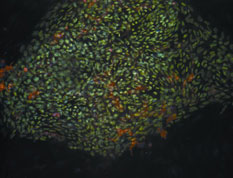
When stem cells like these human embryonic stem cells divide, each new cell has the potential to remain a stem cell or become a cell with a more specialized function, such as a muscle cell or a red blood cell. Photo: National Institutes of Health

When stem cells like these human embryonic stem cells divide, each new cell has the potential to remain a stem cell or become a cell with a more specialized function, such as a muscle cell or a red blood cell. Photo: National Institutes of Health

It’s yet to be determined what the implications of this ruling [PDF] will be if it stands, but it could affect millions of dollars of federally-funded research. AHCJ has some background and links to help reporters who might be looking at how this will affect local researchers.

NIH rules more stem cells eligible for funding

Jul. 7th, 2009 by Scott Hensley · Leave a Comment
Filed under: Government, Health policy 

Right off the bat let’s just note that the promised cures from stem cells have been slow in coming.

Science is hard. But many researchers trying to harness embryonic stem cells, which have the potential to produce any kind of cell in the human body, say restrictions on the cells that qualify for federal funding have made the work even harder. (AHCJ article - Covering stem cells: Background on science, politics and global competition)

Human embryonic stem cellsWhen stem cells like these human embryonic stem cells divide, each new cell has the potential to remain a stem cell or become a cell with a more specialized function, such as a muscle cell or a red blood cell. Photo: National Institutes of Health

Earlier this year the Obama administration rolled back limits from the Bush era that restricted federal funding to only a few cell lines. But it still hasn’t been clear which stem cells are OK and which are verboten.

The National Institutes of Health has waded in with clarifying guidelines that take effect today. The upshot: if the old cell lines were created ethically, then they should be good to go. The main issue is whether researchers got the appropriate consent of donors.

Next up, an NIH committee will pass judgment on existing cells and produce a Web site itemizing the ones that are legit.

“Every institution shouldn’t have to rediscover which cell lines are eligible for NIH funding, so having a registry is very practical,” George Q. Daley, a stem-cell researcher at Children’s Hospital Boston told The New York Times.

AHCJ resourcesCovering stem cells: Background on science, politics and global competition

Tip Sheet: Stem cell research in California

Intense competition in stem cell research: Mark Johnson of the Milwaukee Journal Sentinel writes a three-part series detailing the discovery of how to create embryonic stem cells out of normal cells. The online package includes a time-lapse video of an embryo’s first five days of development and links to a discussion about the ethics of stem cell research.

Obama order expected to increase speed, efficiency of stem cell research

National Center for Biotechnology Information

Medical Advances: Treatments, Cures, Possibilities: Presentations from this Knight Center for Specialized Journalism seminar are available.

NY stem cell researchers can pay egg donors

Jun. 26th, 2009 by Scott Hensley · Leave a Comment
Filed under: Uncategorized 

The ethical thicket that is stem cell research just got a little more complex. New York became the first state to allow taxpayer-funded researchers to pay women to donate eggs specifically for stem cell experiments.

"Stripped" human oocyte; granulosa cells that had surrounded this oocyte have been removed. Courtesy: RWJMS IVF Laboratory via Wikimedia Commons

The compensation could run as high as $10,000. Supporters argue it will spur better, quicker research results. Opponents say paying for eggs crosses an ethical line.

The state board that made the new policy says it’s just like compensating women for donating eggs for reproductive purposes. But the National Academy of Sciences doesn’t see it that way, saying in its guidelines for stem cell research that payment to donors for eggs is a no-no.

Some scientists in the field say the main source now — eggs left over from in vitro fertilization procedures — hasn’t been adequate. (New York won’t pay for those eggs under the new policy anyway.)

Scientists outside New York are already envious. Harvard stem cell researcher George Q. Daley, told The New York Times, the payment policy “will mean a tremendous advantage” for labs in New York.

Obama order expected to increase speed, efficiency of stem cell research (#ahcj09)

Apr. 18th, 2009 by Pia Christensen · Leave a Comment
Filed under: Government 

On the same day that Health Journalism 2009 featured a panel on “Second wind for stem cell research,” The National Institutes of Health issued draft guidelines to allow government funding for stem cell research.

Lawrence Goldstein, Ph.D., a stem cell researcher with the University of California San Diego and a member of the board of the International Society for Stem Cell Research, and Chuck Murry, M.D., Ph.D., co-director of the University of Washington’s Institute for Stem Cell and Regenerative Medicine, commented on the executive order, as well as on the chilling effects of President Bush’s order that limited stem cell research.

Read about what the researches said about the order and the future of stem cell research.

CJR: Be skeptical of miraculous study results

Apr. 15th, 2009 by Andrew Van Dam · Leave a Comment
Filed under: Health journalism, Studies 

In the Columbia Journalism Review, Katherine Bagley urges journalists to use caution when reporting the results of medical studies, citing reports on a recent study on the effectiveness of using stem cells to halt or even reverse multiple sclerosis as an example.

Done with caution and a critical eye, coverage of limited but promising research can provide a needed dose of optimism for people with MS and their families. Unfortunately, in this case, that journalistic prudence was almost totally missing.

Bagley said that, through over-the-top reporting and selective coverage of the small-scale control-free study had inspired false hope and misled readers.

Covering Obama’s stance on stem cell research

Mar. 9th, 2009 by Pia Christensen · Leave a Comment
Filed under: Government, Health policy 

President Barack Obama is expected today to overturn the Bush-era policy that restricted federal funding of embryonic stem cell research. In his official agenda that lays out his positions on issues, Obama said he would “support increased stem cell research. Allow greater federal government funding on a wider array of stem cell lines.”

Human embryonic stem cells
When stem cells like these human embryonic stem cells divide, each new cell has the potential to remain a stem cell or become a cell with a more specialized function, such as a muscle cell or a red blood cell.
Photo: National Institutes of Health

Terri Somers of The San Diego Union-Tribune wrote an article for AHCJ about covering stem cells that includes background on the science, politics and global competition of stem cell research. AHCJ also has a presentation from Zach W. Hall, former president of the California Institute for Regenerative Medicine, that looks at stem cell research in that state. And Al Tompkins at the Poynter Institute provides some background and links on stem cells.

According to Chris Cillizza of The Washington Post, Obama will sign an executive order that will allow study of a broader group of stem cell lines. Cillizza looks at some of the politics surrounding the issue, as well as polls that attempt to measure Americans’ position on stem cell research. The New York Times reports that Obama is leaving some of the more difficult questions about stem cell research to Congress to resolve, such as “whether taxpayer dollars should be used to experiment on embryos.”

Arthur Caplan, Ph.D., director of the Center for Bioethics at the University of Pennsylvania, writes that “This reversal of former President George W. Bush’s ban on such funding is good news for the science needed to find treatments for currently incurable conditions and for the ethics at stake in the issue.”