Bioethicist: Health workers must get H1N1 vaccine

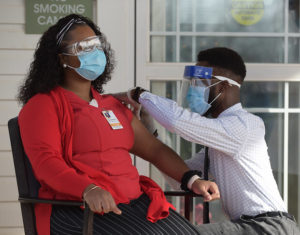
On MSNBC.com, University of Pennsylvania bioethics professor Arthur Caplan takes a tough stand on flu vaccines for health professionals, imploring them to stop “whining” and “moaning.” “Doctors, nurses, respiratory therapists, nurses’ aides, and anyone else who has regular contact with patients ought to be required to get a flu shot or find another line of work,” Caplan writes. According to Caplan, a 100 percent workers’ vaccination rate can cut patient flu deaths and worker sick days by about 40 percent, and thus health workers who claim mandated flu shots are an infringement of their rights are forgetting a key ethical tenet of their profession, that they put the interests of the patient above their own.

flushot

Photo by llu_lu via Flickr

It’s the idea of rights infringement that really sets Caplan off:

Excuse me? What rights might those be? The right to infect your patient and kill them? The right to create havoc in the health care workforce if swine flu hits hard? The right to ignore all the evidence of safety and efficacy of vaccines thus continuing to promulgate an irrational fear on the part of the public of the best protection babies, pregnant women, the elderly and the frail have against the flu? Those rights?

Caplan’s a fellow and former associate director of the Hastings Center, a nonpartisan bioethics think tank.

Related

A just-released survey conducted by the American Society of Health-System Pharmacists finds that health workers are asking pharmacists the same questions (PDF) that patients are asking:

  • Is the H1N1 vaccine safe? (Patients: 52%, Hospital Employees: 54%)
  • Do I need to get the H1N1 vaccine? (Patients: 33%, Hospital Employees: 43%)
  • Will there be enough H1N1 vaccine to around? (Patients: 27%, Hospital Employees: 27%)

The ASHP also says that “While pharmacists are authorized to administer vaccinations to adults [in most states], the survey also finds that most hospitals are not planning to utilize pharmacists for this service. ” The organization - made up of 35,000 members who include pharmacists, pharmacy technicians and pharmacy students - is encouraging hospitals and health systems to use  pharmacists to administer vaccines to increase vaccination rates. The survey also looks at other H1N1 influenza preparedness issues as well.

Swine flu vaccine might be ready this fall

May. 29th, 2009 by Scott Hensley · Leave a Comment
Filed under: Government, Health policy 

If all goes well, a vaccine against the H1N1 flu virus could be available for widespread use by October.h1n1

The Centers for Disease Control and Prevention shipped samples of the swine flu virus to companies working on the vaccine a few days ago, Reuters reports.

Several companies, including AstraZeneca’s MedImmune unit, have begun working on the vaccine. Pilot batches could be ready in a few weeks for testing in people over the summer. Those trials would help determine the right dose and whether an adjuvant is need to get the right response. The feds have committed $1 billion to aid vaccine development.

An adjuvant, or immune-system booster, might also be used to stretch the supply of vaccine so that the batches produced could protect more people, a CDC official told Reuters.

AHCJ resourcesCovering flu, pandemics and preparedness

Separately, China released a group of school children from Maryland who had been held in quarantine since arriving in the country on a trip a week ago. Meanwhile, Chinese authorities reported the first case of swine flu transmitted from one person to another inside the country.